
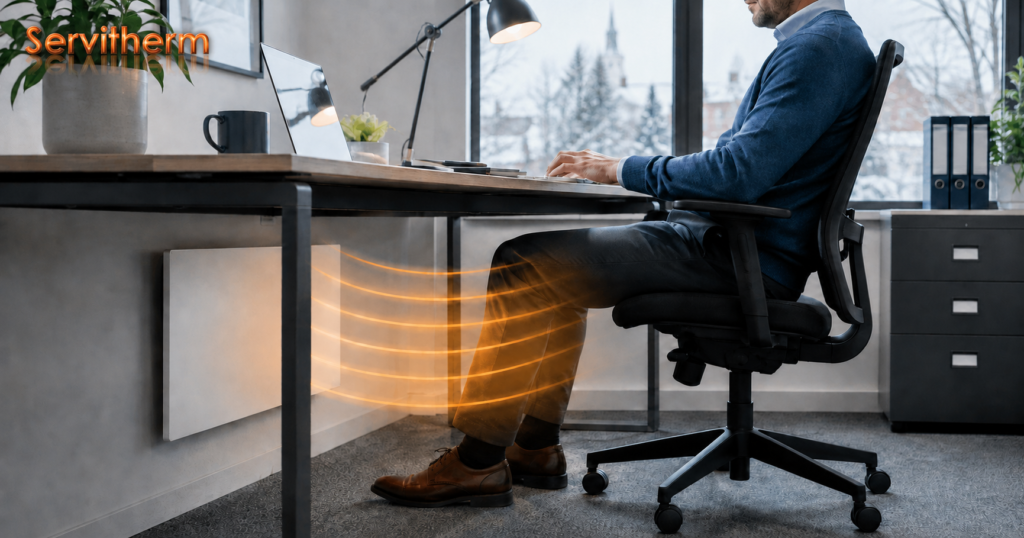
Radiant panel heaters work by warming people, objects and nearby surfaces through thermal radiation. Instead of relying primarily on circulating warm air, the heated face of the panel emits infrared energy into the area in front of it.
When this energy reaches a person, desk, floor or wall, it is absorbed and converted into heat. This creates a direct and comfortable source of warmth, making radiant panels particularly useful for individual workstations, reception desks, ticket offices and other locations where heating an entire room may be unnecessary or impractical.
What Is Radiant Heat?
Radiant heat is energy transferred from a warmer surface to cooler objects and surfaces through electromagnetic waves. It does not need to be carried by moving air.
The easiest comparison is sunlight. You can feel warm in direct sunlight even when the surrounding air remains cool. A radiant panel heater operates at a much lower intensity, but the underlying method of heat transfer is similar.
According to the Health and Safety Executive’s guidance on workplace thermal comfort, radiant temperature can have a greater influence than air temperature on how warm a workplace feels. This is why a relatively low-wattage radiant panel positioned near an occupied area can make a noticeable difference to personal comfort.
What Happens Inside an Electric Radiant Panel Heater?
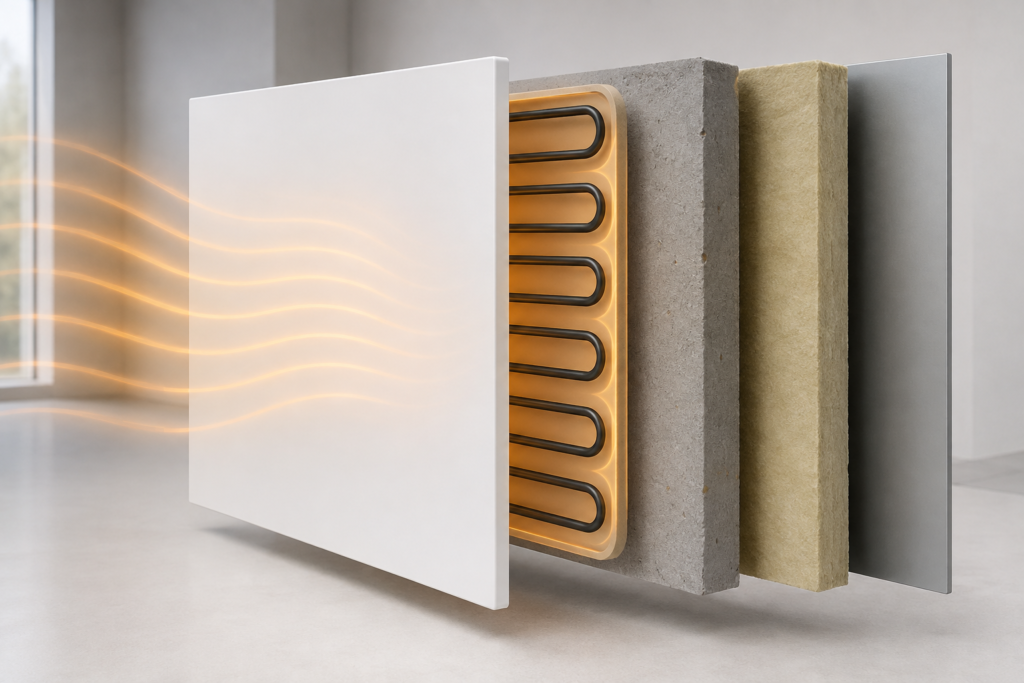
Although construction varies between manufacturers, an electric radiant panel generally contains:
- An electrical heating element
- A flat heat-emitting surface
- Insulating material behind the element
- A protective outer construction
- Temperature controls or a separate thermostat
- A thermal cut-out to prevent overheating
When the heater is switched on, electricity passes through the internal resistance element. Electrical resistance causes the element to become warm, and this heat is transferred across the face of the panel.
The heated surface then releases energy in two ways:
- Thermal radiation travels from the panel towards people and objects within its effective area.
- Natural convection occurs as some of the air touching the warm surface is heated and rises.
Despite the name, a radiant panel does not produce radiant heat exclusively. All warm panels will transfer some heat to the surrounding air. However, radiant heating places greater emphasis on warming people and surfaces than a conventional convector or fan heater.
The CIBSE explanation of radiant heating panels confirms that panel output is predominantly radiant while also including some convective heat from air moving across the panel’s surface.
Do Radiant Panel Heaters Heat the Air?
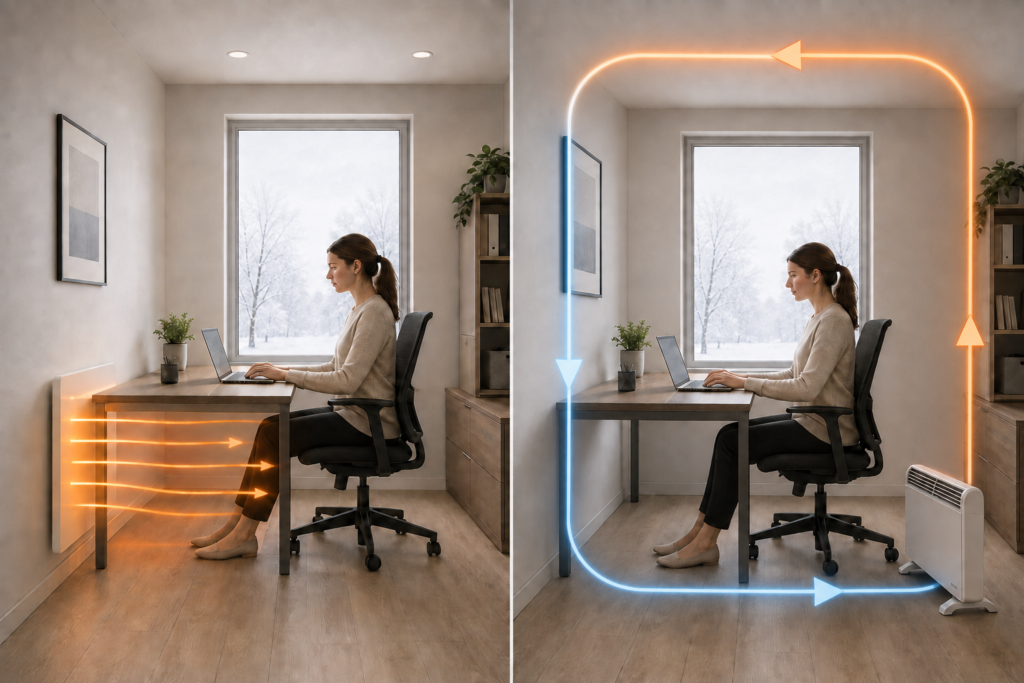
Radiant panels do heat the air to an extent, but they do not depend on heating and circulating large quantities of air to create comfort.
A convector heater draws cooler air across a heating element. The warmed air rises, circulates around the room and gradually increases the overall air temperature. A fan heater accelerates this process by actively blowing heated air into the space.
A radiant panel takes a different approach. Its surface directs thermal energy towards the area in front of it. People and solid objects absorb this energy before gradually releasing some of the warmth into the surrounding environment.
This distinction makes radiant panels particularly valuable in spaces where:
- Staff remain in a relatively fixed position
- Only one part of a room is regularly occupied
- Cold air enters through doors or service windows
- Warm air is easily lost
- Draughts make conventional heating less effective
- There is no need to heat the entire building to the same temperature
The panel can provide warmth where it is actually required rather than using a much larger heating system to raise the temperature of every part of the room.
Why Does Radiant Heat Feel Comfortable?
Thermal comfort is affected by more than the temperature shown on a room thermostat. It is also influenced by air movement, humidity, clothing, activity level and the temperatures of the surrounding surfaces.
For example, a room can have a reasonable air temperature but still feel cold if its windows, walls and floor are particularly cold. The body continues to exchange radiant heat with those colder surfaces.
A radiant panel raises the radiant temperature within its effective area. This reduces the sensation of losing body heat to cold surroundings and allows the occupant to feel more comfortable without necessarily requiring a large increase in the room’s air temperature.
This is especially relevant for people performing sedentary work. Someone seated at a desk produces less metabolic heat than a person walking around or completing physical work, so they may feel cold even when more active colleagues are comfortable.
How Is the Heat Directed?
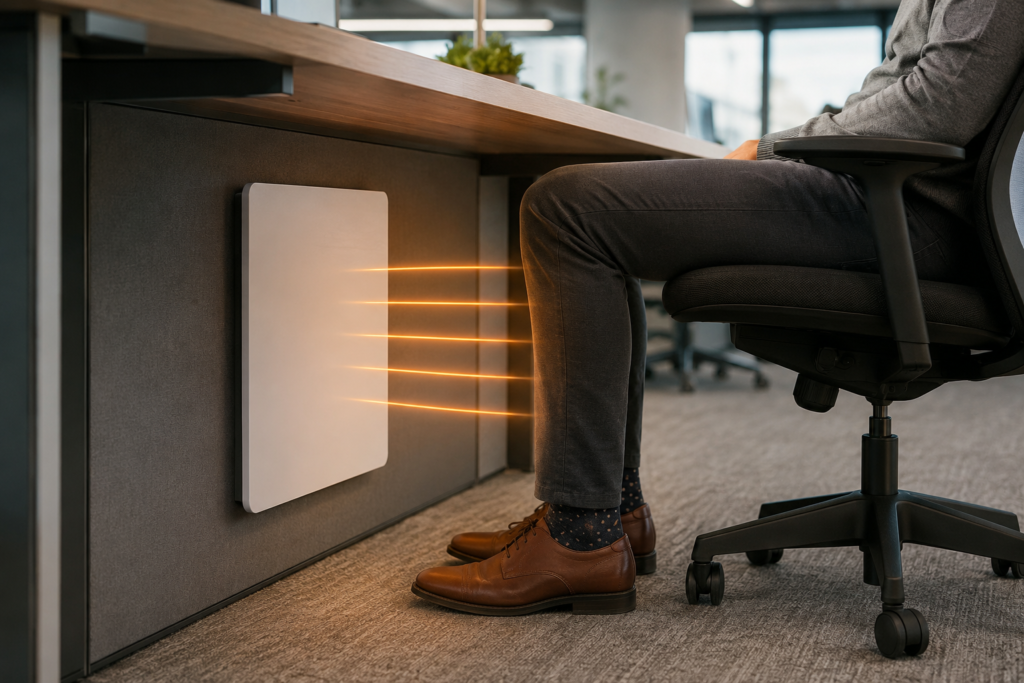
Radiant energy generally travels outwards from the heated face of the panel. The position and orientation of the heater therefore have a considerable effect on performance.
A panel installed beneath a desk should face the occupant’s legs rather than the floor, the back of the desk or an enclosed void. A wall-mounted panel should have a clear path towards the area it is expected to warm.
Furniture, storage boxes and other solid obstructions can intercept radiant energy before it reaches the intended occupant. The obstruction will absorb some heat, but the person behind it will receive less direct warmth.
Effective placement should account for:
- The position of the occupant
- The direction faced by the heated surface
- The distance between the panel and the occupied area
- Furniture or equipment blocking the heat
- The amount of time the position is occupied
- The manufacturer’s required clearances
This line-of-sight characteristic is one reason radiant panels work particularly well as localised heaters. It also means that selecting the correct installation position is just as important as selecting the heater itself.
How Quickly Do Radiant Panel Heaters Work?
A radiant panel begins producing usable warmth as its surface temperature rises. Because some of its energy is transferred directly to occupants and surfaces, the user may begin to feel the benefit before the temperature of the entire room has increased significantly.
However, radiant panel heaters should not be confused with glowing quartz or halogen heaters. Slimline, low-wattage panels usually operate at a gentler surface temperature and provide steady, comfortable warmth rather than an intense blast of heat.
The exact warm-up time depends on:
- The panel’s construction
- Its wattage and dimensions
- Its operating temperature
- The starting temperature of the space
- The distance from the occupant
- How the panel is controlled
Once surrounding surfaces absorb the emitted energy, they can also release some of that warmth back into the space.
Why Can Radiant Panels Use a Lower Wattage?
A low-wattage radiant panel does not create more energy than it consumes. Like other direct electric resistance heaters, it converts electrical energy into heat at the point of use.
Its practical advantage comes from how and where that heat is delivered.
If only one desk, counter or working position needs additional warmth, a local radiant panel may use far less electricity than a higher-powered heater attempting to raise the temperature of the entire room. The saving comes from reducing the area being heated and matching the heat output to the actual requirement.
This makes radiant panels particularly relevant to:
- Under-desk heating
- Reception and security desks
- Retail checkouts
- Ticket offices
- Gatehouses
- Stock rooms
- Church pews
- Kennels and catteries
- Caravans and conservatories
Actual electricity consumption still depends on the heater’s wattage, operating time, thermostat settings and electricity tariff.
How Does a Thermostat Control a Radiant Panel?
A thermostat monitors the temperature and switches the heater on or off as required. Once the selected temperature is reached, electrical power to the panel is interrupted. The heater switches back on when the measured temperature falls.
This means the rated wattage tells you how much electricity the heater draws while actively heating, but it does not necessarily represent continuous consumption throughout the day.
Thermostatic control can:
- Prevent unnecessary operation
- Maintain a more consistent level of comfort
- Reduce overheating
- Limit electricity consumption
- Allow the heater to respond to changing conditions
The thermostat must be positioned carefully. If it is too close to the panel, in direct sunlight or exposed to a cold draught, its reading may not accurately represent conditions in the occupied area.
Are Radiant Panel Heaters the Same as Infrared Heaters?
Radiant panels emit infrared radiation, so they can correctly be described as infrared heaters. However, the term “infrared heater” covers several significantly different products.
It can refer to:
- Low-temperature radiant panels
- High-temperature quartz heaters
- Halogen heaters
- Radiant tubes
- Ceiling-mounted industrial heaters
- Outdoor patio heaters
These products can operate at very different surface temperatures and intensities. A slimline radiant panel generally provides a lower-intensity and more gradual form of heat than a glowing infrared heater.
Understanding this distinction is important when comparing products. Two heaters may both use infrared radiation while being designed for completely different spaces and purposes.
Where Do Radiant Panel Heaters Work Best?
Radiant panel heaters are most effective when they can be positioned with a clear path towards a defined occupied area.
They are especially suited to locations where conventional heating is difficult, inefficient or disproportionate to the size of the area that needs warmth. This includes draught-prone workstations, intermittently occupied rooms and individual positions within larger buildings.
They may be less suitable as the only source of heating in a large space where occupants move constantly and every part of the building must be maintained at an even air temperature. In these circumstances, radiant panels may instead be used alongside the main heating system to address individual cold spots.
Understanding Radiant Panel Heating
In simple terms, a radiant panel heater converts electricity into heat and releases much of that heat from its surface as infrared energy. People, furniture and building surfaces absorb the energy, creating warmth without relying entirely on circulating heated air.
This combination of direct warmth, silent operation and flexible positioning allows radiant panels to solve heating problems that are difficult to address using conventional heaters.
For a broader look at running costs, efficiency, installation, controls and suitable applications, read The Ultimate Guide to Radiant Panel Heaters