

Radiant panel heaters offer a practical way to provide warmth exactly where it is needed. Rather than attempting to increase the air temperature throughout an entire building, a panel can be positioned to direct heat towards a particular person, workstation or occupied area.
This makes radiant heating particularly useful in locations where conventional whole-room heating is inefficient or ineffective, including reception desks, retail checkouts, gatehouses, ticket offices, stock rooms and individual office workstations.
However, not every flat electric heater works in the same way. Panel construction, wattage, surface temperature, positioning and the balance between radiant and convective output all influence how a heater performs.
This guide explains how radiant panel heaters work, what they can and cannot do, where they should be installed and what to consider when selecting one.
What Is a Radiant Panel Heater?
A radiant panel heater is a heating appliance with a broad, heat-emitting surface designed to transfer a significant proportion of its warmth directly towards people, objects and surrounding surfaces.
Inside an electric radiant panel is a resistance heating element. When electricity passes through this element, electrical resistance generates heat. The heat spreads across the panel’s face, creating a relatively large and consistently heated surface.
That surface then releases energy into the area in front of it.
Unlike a fan heater, a radiant panel does not need to blow warmed air around a room. Unlike a conventional convector, it does not depend primarily on air entering through a lower grille, passing across a heating element and rising through an upper outlet.
The absence of a fan allows a radiant panel to operate silently, while its flat construction enables it to fit into positions where a bulkier heater would be impractical.
Depending on its design and intended application, a panel may be installed:
- Beneath a desk
- On a wall
- Behind a counter
- Near a fixed workstation
- Against the rear of fixed seating
- At ceiling level
- Within a small occupied enclosure
- As part of a larger zoned heating system
The term “radiant panel” covers several different types of product. Some are low-wattage electric panels intended to warm one person, while others are larger wall-mounted or ceiling-mounted systems designed to contribute to the heating of a wider space.
It is therefore important to judge a panel by its output, construction and intended use rather than its appearance alone.
How Do Radiant Panel Heaters Work?
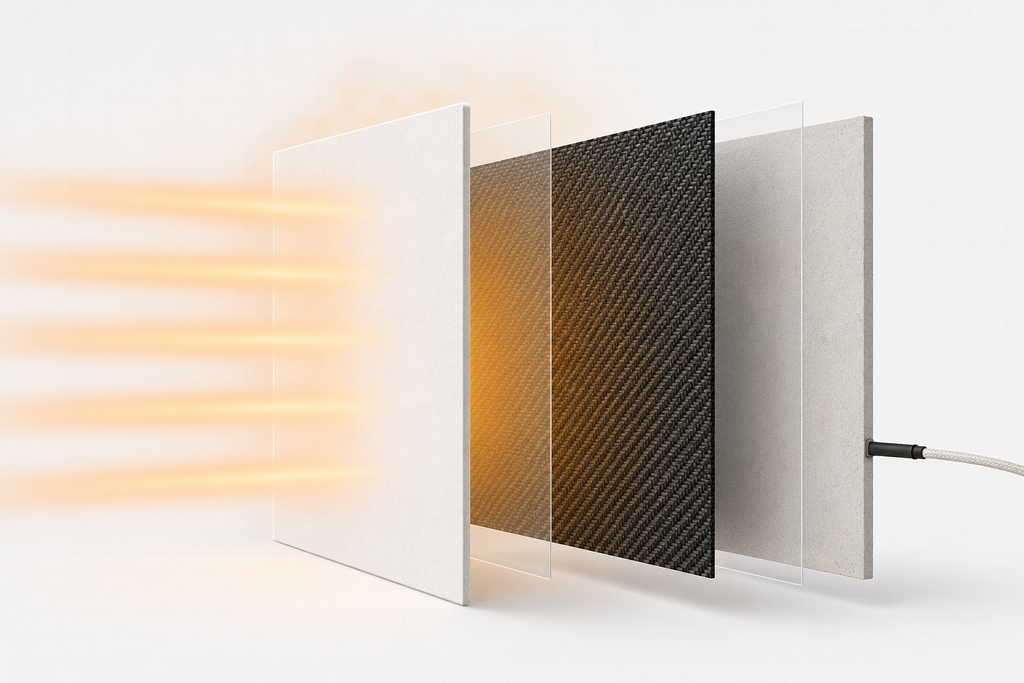
Radiant panel heaters use a combination of radiation and convection, but radiation is the principal method used to deliver warmth towards the intended area.
Once the heating element raises the temperature of the panel face, the surface emits infrared energy. This energy travels through the air and is absorbed by people, clothing, furniture, floors, walls and other solid materials in its path.
The absorbed energy increases the temperature of those surfaces. The warmed objects and materials can then release some of that heat into the surrounding environment.
The process differs from convection heating, where the appliance warms the air first and relies on that air circulating around the room before occupants experience the wider benefit.
The CIBSE explanation of radiant heating panels describes how infrared radiation passes through the air with very little absorption before transferring heat to occupants, objects and surfaces. It also confirms that radiant panels produce some convective output as air moves across the heated surface.
Radiant heat does not make the air irrelevant
It would be inaccurate to say that a radiant panel does not heat the air at all.
Air in direct contact with the warm panel face gains heat and rises naturally. Surfaces warmed by the panel can also transfer heat to the surrounding air. A certain amount of natural convection is therefore unavoidable.
The distinction is that a radiant panel does not need to heat and circulate the entire volume of air before it can provide useful warmth to someone positioned in front of it.
The proportion of radiant and convective output varies between heater designs. Panel temperature, dimensions, surface material, mounting orientation and surrounding air movement can all affect the balance.
A more detailed explanation of this process is available in the following article How Do Radiant Panel Heaters Work?
Radiant heat requires a clear path
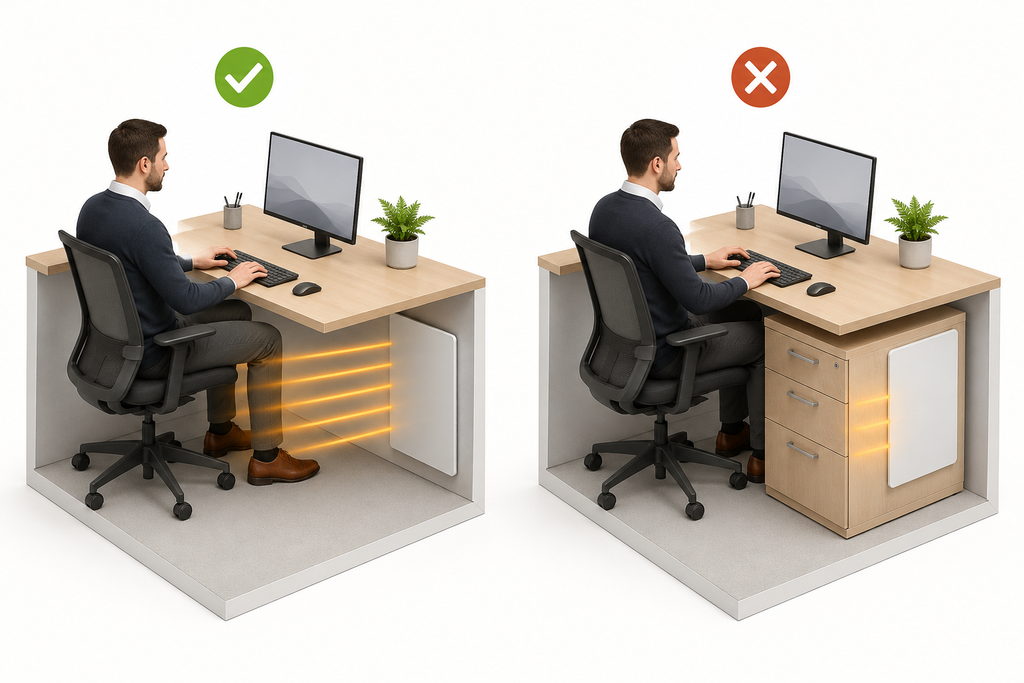
Infrared energy travels away from the panel in a broadly direct path. If a solid object stands between the panel and the intended occupant, that object will absorb or redirect part of the energy.
For example, an under-desk panel will be far less effective if its heat-emitting face is directed towards:
- The back of the desk
- A drawer unit
- Stored boxes
- A solid modesty panel
- An empty walkway
- The floor rather than the user
The panel’s broad front face should be directed towards the person or area that requires warmth.
This line-of-sight principle is one of the most important differences between radiant and convective heating. A convection heater can gradually warm air that travels around some obstacles, whereas a solid obstruction can prevent direct radiant energy from reaching its intended target.
What Does Radiant Heat Feel Like?
Radiant warmth can be felt even when the surrounding air remains relatively cool.
A familiar example is standing in sunlight on a cold day. The air temperature may be low, but the exposed side of the body feels warmer because it is receiving radiant energy. A radiant panel produces warmth at a much lower intensity, but the underlying heat-transfer principle is similar.
The sensation differs from entering a room that has been heated entirely through convection. In a convectively heated room, the occupant experiences warmth primarily because the surrounding air temperature has increased. With a radiant panel, the user may feel direct warmth before a substantial change in the room’s general air temperature occurs.
This distinction is particularly useful when one person remains in a fixed position.
If an employee feels cold at a reception desk, for example, increasing the temperature throughout the building may:
- Use unnecessary energy
- Make other occupants uncomfortable
- Take time to affect the cold position
- Provide limited benefit if an entrance door opens frequently
A correctly positioned radiant panel can instead address the occupied position directly.
Thermal comfort involves more than air temperature
People do not experience temperature through air temperature alone.
The UK Health and Safety Executive identifies six principal factors affecting workplace thermal comfort:
- Air temperature
- Radiant temperature
- Air movement
- Humidity
- Clothing
- Work rate
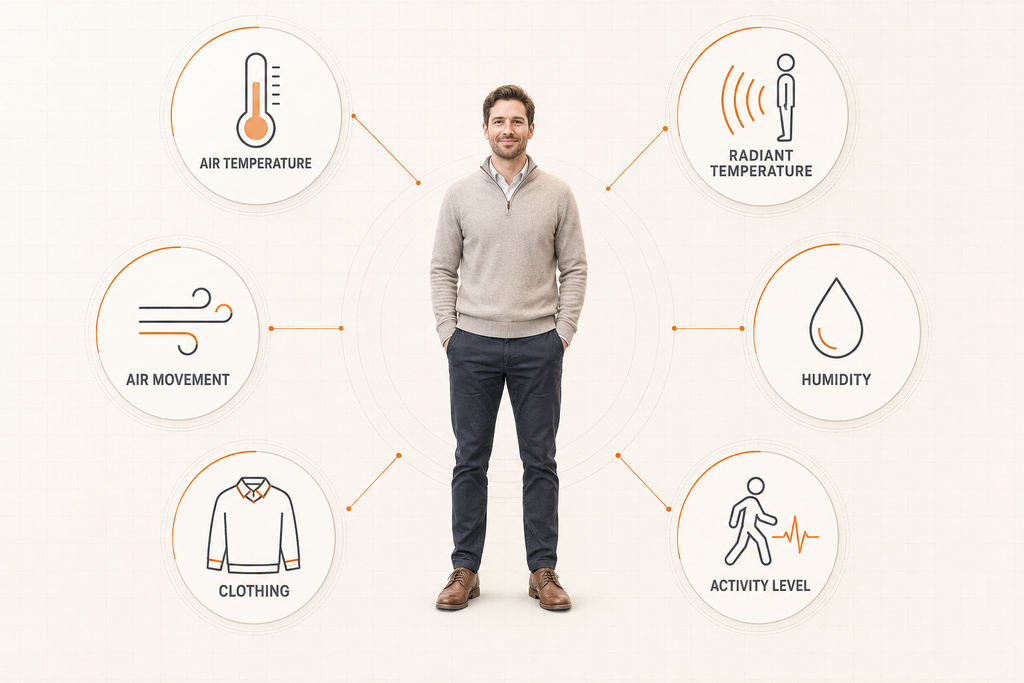
The HSE’s workplace thermal-comfort guidance explains that radiant temperature can exert a greater influence than air temperature on how hot a workplace feels.
This helps explain why someone may still feel cold in a room where a wall thermostat displays what appears to be a reasonable temperature.
The person continually exchanges radiant heat with surrounding surfaces. If nearby windows, walls, floors or furniture remain cold, the body can lose heat towards them. Air movement across the person can increase the sensation of cooling further.
A radiant panel can improve local comfort by increasing the radiant energy received within the occupied area. It does not necessarily need to raise the temperature of every cubic metre of air to the same extent.
Thermal comfort remains subjective, however. Clothing, activity level, age, individual preference, draughts and the distance from the heater will affect how much warmth a person experiences.
Radiant Panel Heaters vs Convection Heaters
The fundamental difference is what each heater warms first.
A radiant panel directs much of its output towards solid matter, including people and surfaces. A convection heater transfers most of its output into the surrounding air and relies on circulation to distribute that heat.
Both appliances ultimately produce heat from electricity. A 500W radiant heater does not generate more energy than a 500W convection heater simply because the method of delivery is different.
The practical difference concerns where that heat goes and how much of the surrounding space must be warmed to resolve the actual comfort problem.
Radiant heating is directional
A radiant panel is most effective within the area facing its heat-emitting surface.
This makes it particularly suitable for:
- One seated employee
- A fixed counter position
- An individual church pew
- A ticket-office workstation
- A reception desk
- A frequently occupied gatehouse
- A defined area within a larger room
The benefit becomes weaker outside the panel’s effective area or when furniture blocks the radiant path.
Convection heating is intended to circulate
A convection heater warms nearby air. As the air becomes warmer and less dense, it rises. Cooler air moves towards the heater to replace it, establishing a circulation pattern.
This makes convection heating better suited to maintaining the general air temperature throughout a reasonably enclosed room, particularly when occupants move between different positions.
However, warm air can escape when external doors open, and temperatures can vary vertically because heated air naturally rises towards the ceiling.
Neither method is universally better
Radiant heating is not automatically the correct choice for every room, and convection heating is not inherently inefficient.
A convection heater may be more appropriate when:
- The entire room is occupied
- People move around frequently
- Doors and windows normally remain closed
- A consistent general air temperature is required
- There is sufficient space for air to circulate
A radiant panel may be more appropriate when:
- Only one position requires additional warmth
- The occupant remains seated or stationary
- The space is draughty
- An external door opens regularly
- Heating the entire room would be unnecessary
- Silent operation is important
- Available floor space is limited
The differences are examined more closely in the supporting article Radiant Panel Heaters vs Convection Heaters: What Is the Difference?
Different Types of Radiant Panel Heater
Radiant panel heaters are available in several formats. The correct type depends on whether the objective is to warm one person, an occupied zone or a larger room.
Low-wattage personal radiant panels
Personal radiant panels are designed to provide localised supplementary warmth.
They are commonly installed beneath desks, behind counters or near individual fixed workstations. Their relatively low wattage reflects the fact that they are not attempting to heat the entire room.
A low-wattage panel may be suitable when the main heating system already maintains a background temperature but one person experiences a persistent cold spot.
It should not be treated as a direct replacement for a high-output whole-room heater.
Wall-mounted radiant panels
A wall-mounted panel can direct heat towards a bed, seating position, desk or defined occupied area.
Its effectiveness depends on mounting height, orientation, distance and whether furniture interrupts the radiant path. A convenient empty section of wall is not necessarily the correct installation position if the panel does not face the intended user.
Larger wall-mounted infrared panels may contribute more substantially to room heating, but their required output must still be assessed against the size, heat loss and use of the space.
Under-desk radiant panels
Under-desk panels are intended to warm the lower body of a seated user.
The panel should be mounted securely with its heat-emitting face directed towards the legs. It must retain adequate clearance from the occupant, furniture, cabling, papers and stored items.
This type of installation can be useful where one employee feels cold but increasing the central heating would make the rest of the workplace too warm.
Ceiling-mounted radiant panels
Ceiling-mounted systems direct radiant energy towards the occupied space below. They are used in environments ranging from offices and healthcare buildings to halls and other larger spaces.
Because these products may form part of a designed building heating system, they differ considerably from low-wattage personal electric panels.
The UK Government’s research into infrared heating notes that panel position, controls, insulation and occupant behaviour can all influence real-world performance. Product selection should therefore be based on the building and application rather than broad claims about infrared heating as a category.
Portable and freestanding panels
Some radiant panels are supplied with feet or portable supports.
They can provide flexibility, but portability also creates additional considerations:
- The heater may be moved into an ineffective orientation.
- Furniture may block its output.
- Cables can create trip hazards.
- The panel may be positioned too close to combustible materials.
- The unit can be knocked over or damaged.
A securely fixed panel is often more appropriate for a permanent workstation because its position and orientation remain consistent.
High-temperature infrared heaters
Not every infrared heater is a low-temperature radiant panel.
High-temperature infrared appliances may use quartz elements, glowing bars or other concentrated emitters. These products can deliver intense directional heat but have different surface temperatures, clearances, controls and suitable applications.
They should not be confused with slim, lower-temperature panels intended for close-range personal or workplace heating.
Whole-surface infrared systems
Some systems incorporate electric heating elements across large sections of a wall or ceiling. These systems distribute radiant output across a much greater area than a small personal panel.
The Energy Saving Trust’s explanation of infrared electric wall heating illustrates the distinction between heating systems that warm people and surfaces through infrared radiation and conventional emitters that predominantly warm and circulate air.
These larger systems require a different approach to design, installation and cost assessment. Their performance cannot be inferred from the wattage or experience of a small under-desk panel.
Understanding the Purpose of the Panel
Before comparing wattages, dimensions or controls, establish what the heater is expected to achieve.
Is it intended to:
- Warm one seated person?
- Resolve a cold spot near an entrance?
- Supplement an existing heating system?
- Maintain comfort at a reception or checkout?
- Warm an individual seating area?
- Contribute to the heating of an entire room?
These are different requirements and may need very different products.
Radiant panels are at their most effective when the heating objective is clearly defined. A correctly selected panel can provide focused, silent warmth without unnecessarily heating unused space. An undersized or poorly positioned panel, however, will not perform effectively simply because it uses radiant heat.
The next section explains how to assess the application, choose an appropriate output and position the panel so that its heat reaches the intended occupant.
Where Can Radiant Panel Heaters Be Used?
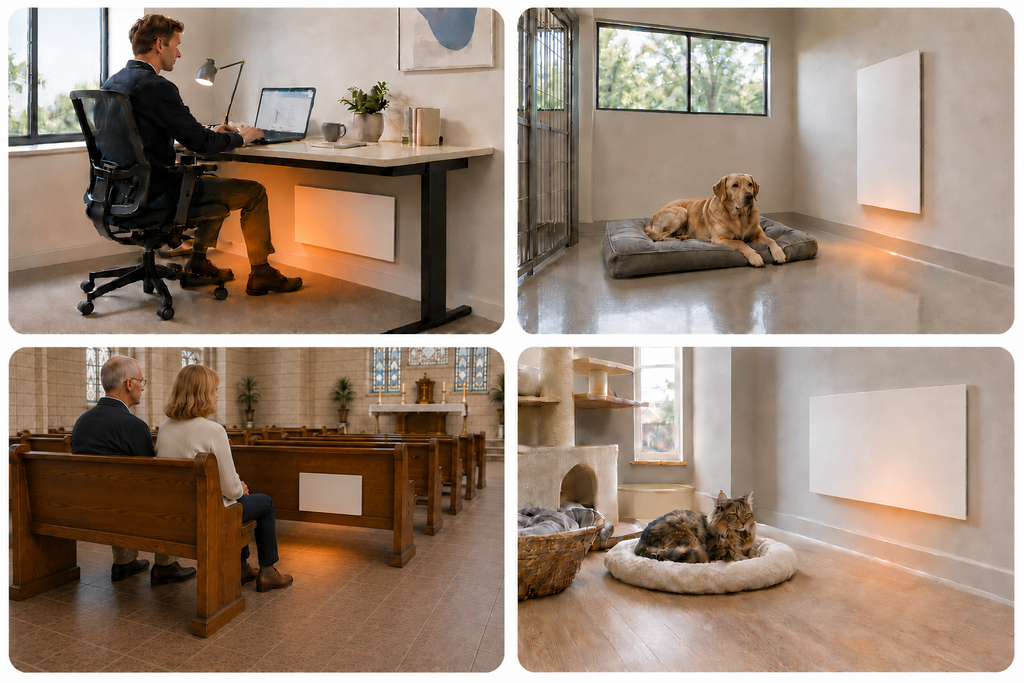
Radiant panel heaters are particularly useful where warmth is required within a defined occupied area rather than across an entire building.
Their slim construction allows them to fit beneath desks, behind counters, against walls and within other restricted spaces. Because they operate without a fan, they can also provide localised warmth without introducing mechanical noise or strong air movement.
The suitability of any installation still depends on the panel’s wattage, dimensions, surface temperature, electrical classification and mounting requirements.
Offices and individual desks
Temperature complaints in offices are often localised. One employee may sit near a window, external wall or frequently opened door while colleagues elsewhere in the room remain comfortable.
Increasing the central heating to resolve one cold workstation may make the rest of the office unnecessarily warm.
An under-desk radiant panel can instead direct warmth towards the affected employee. Because the user remains in a relatively fixed position, the panel does not need to heat the full volume of air throughout the office before providing a benefit.
The panel should face the user’s lower body and remain clear of drawer units, stored boxes, cables and other obstructions.
Reception desks and entrance areas
Receptionists frequently work close to external doors. Each time the door opens, heated indoor air can escape and colder outdoor air can enter.
A convection heater must repeatedly warm this replacement air. A radiant panel can continue directing energy towards the receptionist, even when the general air temperature fluctuates.
Severe draughts will still affect comfort, but localised radiant heat can be more practical than attempting to maintain a high temperature across an entire entrance area.
Retail checkouts
Checkout operators often remain in one position for extended periods. The location may also be affected by customer entrances, open shop fronts or air movement from ventilation systems.
A correctly positioned panel can provide local warmth without heating customers, adjacent aisles or unoccupied areas unnecessarily.
Installation must not obstruct the operator, customer access, electrical equipment or the movement of trolleys and baskets. The panel should be fixed securely so that it cannot be knocked or displaced during normal use.
Ticket offices and gatehouses
Ticket offices, security huts and gatehouses are usually compact, but they may have frequently opened doors or service windows.
These environments can experience rapid changes in air temperature despite their limited size. A low-wattage radiant panel positioned towards the occupied seat can provide supplementary warmth without requiring a high-output portable heater.
Any heater used within a small enclosure must have suitable clearance from paperwork, clothing, furniture and other combustible materials.
Stock rooms and fixed packing stations
A large stock room may only contain one or two regularly occupied workstations. Heating the entire space to the same temperature as a small office can be inefficient, especially where ceilings are high or loading doors open throughout the day.
Radiant panels can be used to support individual packing benches, desks or fixed working positions.
They are less suitable when employees constantly move around the stock room because a person outside the panel’s effective area will receive less direct warmth.
Churches and fixed seating
Churches are often challenging to heat because they combine high ceilings, large internal volumes, intermittent occupancy and traditional building materials.
Localised radiant panels can be installed near individual pews or other fixed seating areas, allowing warmth to be directed towards occupants without first raising the air temperature throughout the entire building.
The installation must respect the structure and appearance of the seating while maintaining safe clearances. The panel’s heat-emitting face should point towards the seated occupants rather than directly into the timber backrest.
Caravans and compact accommodation
Floor and wall space are limited in caravans, cabins and similar accommodation.
The slim profile of a radiant panel can make it easier to integrate than a freestanding convector. However, compact spaces also increase the likelihood of bedding, clothing, curtains or furniture being placed close to the heater.
Only a product approved for the intended environment should be installed, and all manufacturer-specified clearances must be maintained.
Kennels and catteries
Radiant panels can provide localised warmth within kennels, catteries and other animal accommodation without relying on fan-assisted air movement.
The heater must be positioned where animals cannot damage the panel, cable, plug or controls. It must also be protected from direct water exposure unless the specific model has an appropriate ingress-protection rating.
The animal must be able to move away from the heated area. The panel should provide a warm zone rather than exposing the entire enclosure to unavoidable direct heat.
Bathrooms and changing areas
A radiant panel may be suitable for some bathrooms, changing areas and similar locations, but product selection is critical.
The panel must have an appropriate IP rating and be installed outside any location prohibited by its instructions. Bathroom electrical zones affect which equipment can be installed and what degree of protection is required.
A general-purpose heater should never be assumed suitable simply because its surface appears resistant to moisture.
When Is a Radiant Panel the Right Choice?
A radiant panel is most effective when the heating requirement can be clearly defined.
It may be the right choice when:
- One person or workstation requires additional warmth.
- The occupant remains in one position for extended periods.
- The space is affected by draughts or frequently opened doors.
- Heating the entire room would be unnecessary.
- Floor space is limited.
- Silent operation is important.
- Strong air movement would be uncomfortable.
- The existing heating system needs localised supplementation.
- A slim heater is easier to integrate than a freestanding appliance.
Radiant panels can be particularly effective as part of a zoned approach. The main heating system maintains a reasonable background temperature while individual panels address colder positions.
This does not mean that the background heating should always be turned off. The building still needs appropriate heating, ventilation and moisture management. The radiant panel addresses a specific comfort requirement rather than every aspect of the internal environment.
When Might a Radiant Panel Not Be Suitable?
Radiant panels are not universal replacements for central heating, convection heaters or properly designed whole-building systems.
A panel may not be the best choice when:
- Occupants move continuously between different positions.
- A consistent temperature is needed across an entire room.
- Furniture prevents a clear radiant path.
- The available mounting position is too close to the user.
- One small panel is expected to heat a large open space.
- The installation environment is unsuitable for the product’s electrical rating.
- The panel cannot be mounted securely.
- Clothing, paper or stored materials are likely to cover it.
- The required clearances cannot be maintained.
A panel can also perform poorly when it has been selected entirely by physical size. Two panels with similar dimensions may have different outputs, surface temperatures and intended applications.
The decision should begin with the heating requirement, not the space available on the wall.
How Much Heating Output Do You Need?
Radiant panel output is measured in watts. Wattage indicates the rate at which the appliance uses electrical energy and produces heat.
A 300W panel uses more electricity and produces heat at a greater rate than a 100W panel when both operate continuously. However, the higher-wattage product is not automatically the better choice.
The correct output depends on what the panel needs to accomplish.
Personal heating and whole-room heating are different calculations
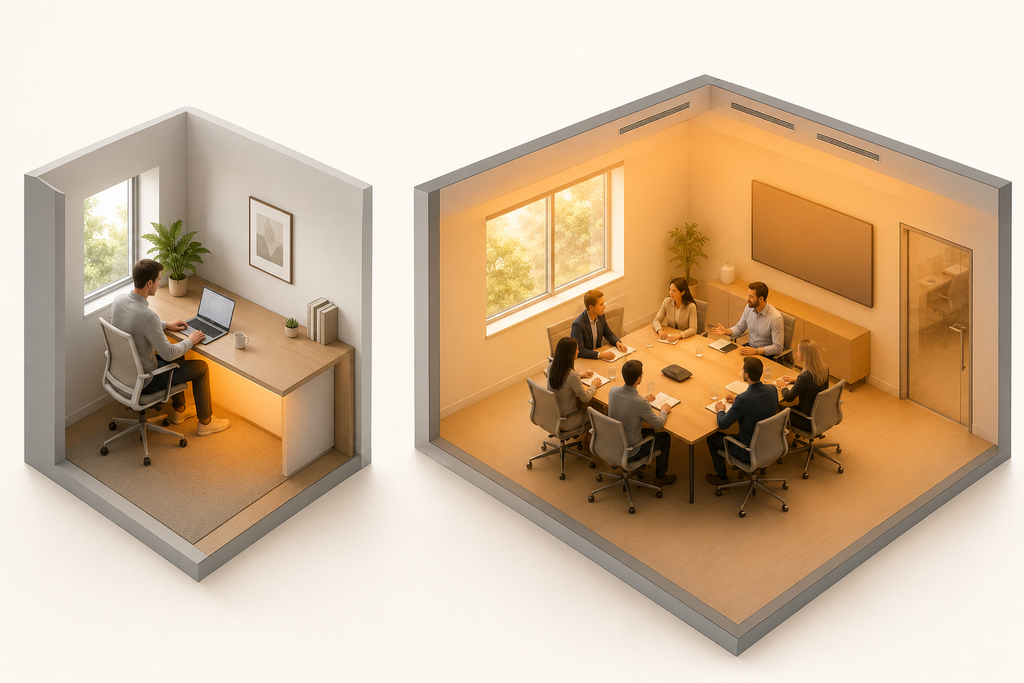
A personal radiant panel is selected to deliver useful warmth towards one occupied position. Its effectiveness depends on:
- Distance from the user
- Panel dimensions
- Surface temperature
- Direction of the emitting face
- Length of time the position is occupied
- Clothing and activity level
- Draughts around the workstation
- Temperature of surrounding surfaces
- Existing background heating
Whole-room heating requires a broader assessment of the building’s heat loss. This may include:
- Floor area
- Ceiling height
- Insulation
- Window type and area
- Number of external walls
- Air leakage
- Ventilation
- Desired internal temperature
- Typical external temperature
- Occupancy pattern
A low-wattage personal heater should not be selected using a generic watts-per-square-metre room calculation and then expected to heat the entire space.
Avoid choosing the largest panel automatically
Excessive output can make direct warmth uncomfortable, particularly when the panel is positioned close to the user. It may also increase electricity consumption without improving overall comfort.
Insufficient output can leave the occupant cold or encourage continuous operation without providing the required result.
The aim is to match the panel to the occupied area, installation distance and surrounding conditions.
The Servitherm Slimline Panel Heater range includes models operating from 100W to 310W. The range allows the output and physical panel size to be selected around the intended application rather than using one model for every position.
Where the correct output is uncertain, obtain application-specific advice instead of relying solely on room dimensions.
How to Position a Radiant Panel Correctly
Positioning can have as much influence on performance as wattage.
A radiant panel must have a clear path towards the person, object or area it is intended to warm. The emitting face should be visible from the occupied position wherever practical.

Face the intended occupant
The panel should not be installed simply where there happens to be an empty surface.
Before fixing it, identify:
- Where the person normally sits or stands.
- Which part of the body requires additional warmth.
- Whether furniture will interrupt the radiant path.
- Whether the position maintains the required clearances.
- Whether the cable can reach the supply safely.
- Whether the panel could be knocked or damaged.
A panel facing away from the occupant may warm the desk, wall or stored equipment instead.
Avoid solid obstructions
Common obstructions include:
- Drawer pedestals
- Desk modesty panels
- Filing cabinets
- Computer equipment
- Waste bins
- Stored boxes
- Bags
- Coats
- Upholstered furniture
- Fixed partitions
An obstruction does not cause the energy to disappear. It absorbs the radiant heat before it reaches the intended occupant, potentially warming an unsuitable surface.
Consider distance as well as direction
Placing a panel very close to the user does not always produce better comfort. Direct warmth may become concentrated or uneven, and insufficient clearance can create a safety concern.
Positioning it too far away may reduce the useful heat reaching the occupied area.
Follow the installation distances supplied for the specific product. Do not copy the position used for a different model with another wattage or surface temperature.
Under-Desk Installation
An under-desk radiant panel should normally be mounted vertically with its broad face directed towards the seated user’s legs.
Before installation, check the entire area beneath the desk.
The proposed position should:
- Preserve adequate legroom.
- Avoid contact with knees, shins and footwear.
- Keep the panel away from loose cables.
- Remain clear of paper and stored belongings.
- Avoid the underside of drawers.
- Prevent the panel from being kicked or struck.
- Allow the power cable to reach the socket without stretching.
- Keep controls accessible where applicable.
The panel should be attached using the correct mounting system. Improvised tape, unsupported brackets or loose fixings may allow the panel to fall, tilt or face the wrong direction.
Keep the space beneath the desk clear
Under-desk spaces often accumulate handbags, cardboard boxes, coats, paperwork and portable electrical equipment.
These items can block the heat, create unsafe clearances or rest directly against the panel. The area should be inspected periodically rather than assumed to remain clear after installation.
Users should be told not to cover the heater or move storage into its operating space.
Protect the cable
The supply cable should not cross a walkway, pass beneath chair wheels or hang where it can be caught by the user’s feet.
Do not trap the cable between furniture panels or route it across a hot surface. If the supplied cable cannot reach a suitable socket safely, obtain installation advice rather than using an unsuitable extension lead.
Wall and Fixed-Seating Installation
Wall-mounted panels should face the area that requires warmth while remaining protected from accidental contact and obstruction.
The appropriate height depends on the panel’s dimensions, output and intended target. A panel installed too high may direct much of its energy above a seated occupant, while one installed too low may be vulnerable to impact.
For fixed seating, such as church pews, the panel should be attached securely and direct warmth towards the occupant. It should not simply heat the back of the seat.
Installers should also consider:
- Cleaning access
- Cable routing
- Nearby timber or upholstery
- The likelihood of accidental contact
- The movement of chairs or equipment
- Access to switches and controls
- The manufacturer’s required clearances
Where a panel is installed in a public or commercial area, the mounting arrangement should account for foreseeable misuse as well as normal operation.
Electrical and Safety Considerations
A radiant panel is still an electrical heating appliance. Low wattage does not remove the need for safe installation and operation.
Use a suitable power supply
Plug-in panels should be connected in accordance with the manufacturer’s instructions.
Avoid routing the supply through an overloaded adaptor or extension lead. The plug and socket should remain accessible, undamaged and free from signs of overheating.
Electrical Safety First advises users to keep electric heaters away from combustible materials, avoid obstructing them and avoid powering portable heaters through extension leads. Its guidance on using electric heaters safely also recommends checking plugs, sockets and cables for damage or overheating.
If a heater causes a plug or socket to become unusually hot, produces a burning smell, trips a protective device or shows visible damage, stop using it and arrange an appropriate inspection.
Do not cover the panel
Clothing, towels, paper, bedding and other materials should not be placed over a radiant panel unless the manufacturer has expressly designed the product for that purpose.
Covering the surface can trap heat and prevent the heater from operating as intended.
This requirement is especially important in airing cupboards, bathrooms, bedrooms, animal accommodation and under-desk installations where materials may be placed against the heater unintentionally.
Consider surface temperature
A working radiant panel has a deliberately warm surface.
The installation should reduce the likelihood of prolonged accidental contact, particularly in environments occupied by:
- Young children
- Older people
- Animals
- People with reduced mobility
- People with reduced sensitivity to temperature
- Members of the public unfamiliar with the appliance
Guards or alternative positioning may be necessary in some applications, but any guard must be approved for use with the panel and must not obstruct its heat output or cause overheating.
Check the IP rating
An IP rating indicates the degree of protection an enclosure provides against the entry of solid objects and water.
The required rating depends on the environment and installation position. A panel used in a dry office does not face the same conditions as one installed in a bathroom, kennel, changing area or other damp location.
Do not describe a product as waterproof unless its documented rating and installation instructions support that claim.
Bathrooms are special locations
Electrical equipment installed near a bath or shower is subject to additional requirements.
The IET’s guidance on BS 7671 requirements explains that bathrooms are treated as special locations and that equipment installed within defined zones must have an appropriate IP rating. The location, electrical connection, RCD protection and manufacturer’s instructions must all be considered.
A panel that is suitable for one part of a bathroom may not be suitable for another.
Where fixed electrical work is required, it should be assessed and completed by someone with the necessary competence.
Follow the instructions for the specific model
Installation requirements are not interchangeable between products.
Always confirm:
- Permitted mounting orientation
- Minimum clearances
- Suitable environments
- IP rating
- Electrical supply requirements
- Surface temperature
- Fixing method
- Thermostat compatibility
- Whether the product is portable or fixed
- Whether professional installation is required
Correct selection and positioning allow a radiant panel to deliver focused warmth effectively. The third section will explain how controls, operating time and wattage affect running costs, along with maintenance requirements and the final points to check before choosing a heater.
How Should a Radiant Panel Heater Be Controlled?
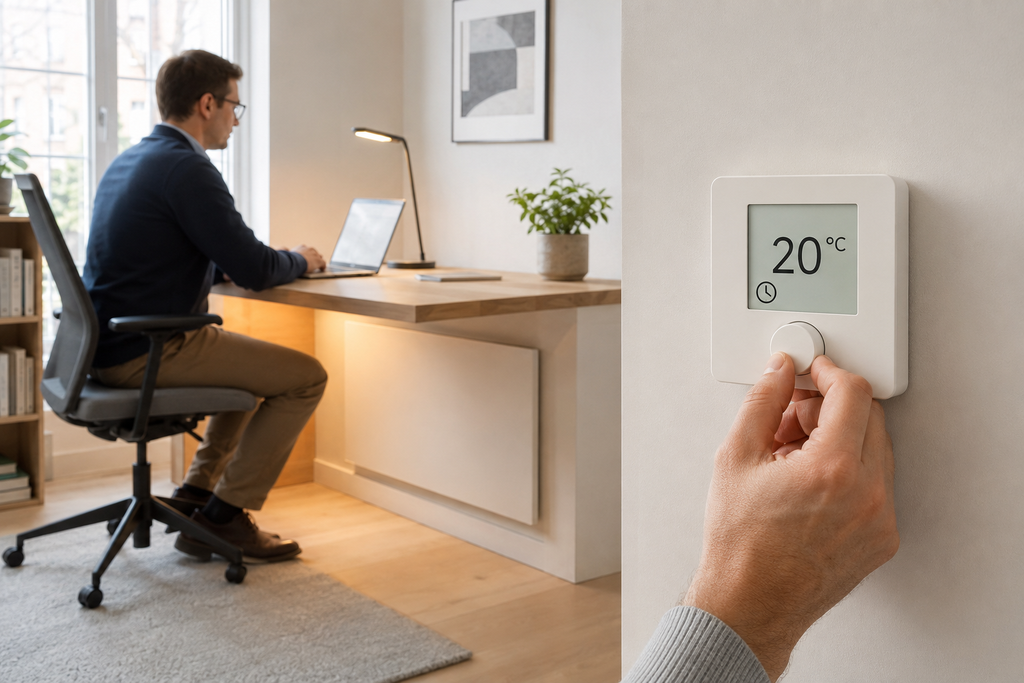
A radiant panel should only operate when and where its heat is required.
Without suitable control, even a low-wattage heater can consume unnecessary electricity during unoccupied periods. The appropriate control method depends on whether the panel provides personal heating, supplements another system or contributes to the general heating of a room.
Available controls may include:
- A simple on-and-off switch
- A plug-in timer
- A room thermostat
- A local thermostat
- A programmable controller
- An occupancy sensor
- A central building-management system
Not every control is compatible with every panel. Check the heater’s electrical rating and the manufacturer’s instructions before connecting a separate thermostat, timer or switching device.
Manual switches
A local switch gives the user immediate control over the panel. This can work well at an individual workstation, provided the occupant remembers to turn the heater off when leaving.
The switch should remain accessible without requiring the user to reach behind the hot surface or move furniture.
Manual control is less reliable in communal areas where responsibility for switching the heater off is unclear.
Timers
A timer can limit operation to expected occupancy periods.
For example, a panel serving a reception desk could be scheduled to operate during opening hours rather than remaining on overnight. A timer can also prevent a heater from being left on throughout weekends or holiday periods.
The schedule should reflect actual occupancy rather than simply copying the operating times of the building’s main heating system.
Thermostats
A thermostat switches or regulates the heater in response to temperature.
Positioning is important. A thermostat installed directly above the panel, in strong sunlight, beside an external door or against a particularly cold surface may not measure representative conditions.
A thermostat controlling localised radiant heat also needs to reflect the purpose of the installation. The objective may be to improve comfort at one desk rather than achieve the same air temperature across the entire room.
Occupancy-based control
An occupancy sensor can prevent a panel from heating an unused workstation.
This can be useful in:
- Hot-desking offices
- Ticket offices with changing operating hours
- Meeting areas
- Intermittently occupied gatehouses
- Churches
- Seasonal counters
- Shared workstations
A short delay may be appropriate to prevent the panel switching off whenever the occupant remains still for a brief period.
Combining background and personal heating
Radiant panels can be used alongside a central heating system.
The central system maintains a moderate background temperature, while local panels provide additional warmth at colder occupied positions. This can be more practical than increasing the temperature throughout the building to satisfy one person.
The background temperature must still be appropriate for the building, its occupants and its use. Localised panels should not be used to conceal a failed heating system, severe fabric defects or working conditions that require a wider solution.
How Much Does a Radiant Panel Heater Cost to Run?
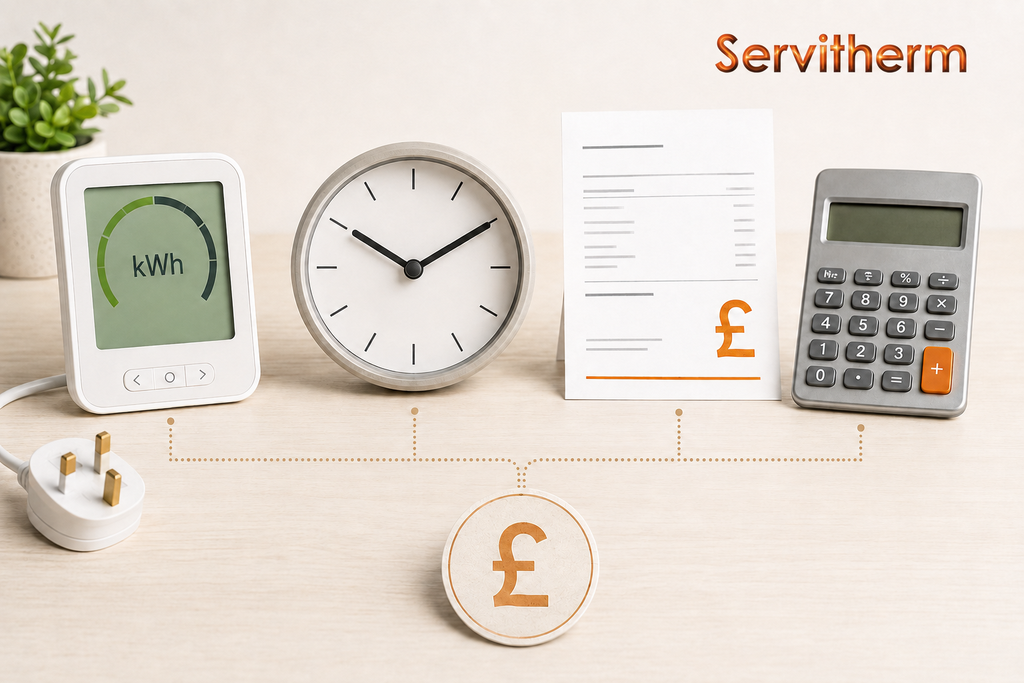
The direct running cost is determined by three figures:
- The heater’s wattage
- The length of time it operates
- The electricity unit rate
The calculation is:
Wattage ÷ 1,000 × hours used = electricity consumed in kilowatt-hours
The result can then be multiplied by the electricity price:
Electricity consumed in kWh × unit rate = running cost
Worked hourly examples
At an illustrative electricity rate of 26.11p per kWh:
| Panel output | Electricity used in one hour | Approximate hourly cost |
|---|---|---|
| 100W | 0.10kWh | 2.61p |
| 210W | 0.21kWh | 5.48p |
| 260W | 0.26kWh | 6.79p |
| 310W | 0.31kWh | 8.09p |
The 26.11p rate reflects Ofgem’s average capped electricity unit rate for a Direct Debit customer between 1 July and 30 September 2026. The current Ofgem energy price cap rates vary by region, payment method and tariff.
Always use the unit rate shown on the actual electricity bill when calculating expected costs.
Standing charges have not been included because these are normally payable regardless of whether the heater is used.
Example daily calculation
Suppose a 210W panel operates for six hours:
210 ÷ 1,000 × 6 = 1.26kWh
At 26.11p per kWh:
1.26 × £0.2611 = approximately £0.33
Its approximate running cost would therefore be 33p for that six-hour period if it operated continuously.
Over five working days:
£0.33 × 5 = approximately £1.65
Actual consumption may be lower if a compatible thermostat switches the heater off for part of that period.
Wattage sets the maximum rate of consumption
A 310W panel cannot consume 1kWh in a single hour under normal operation because its rated input is 0.31kW.
Likewise, a 100W panel operating continuously for ten hours would consume approximately 1kWh:
100 ÷ 1,000 × 10 = 1kWh
This makes wattage a useful starting point when comparing products. However, selecting the lowest wattage is not always economical if the panel cannot provide the required warmth.
An undersized heater may operate continuously without resolving the problem. A correctly selected panel controlled around occupancy may produce a better result.
For more running-cost examples and an explanation of thermostat cycling, see How Much Does a Radiant Panel Heater Cost to Run?
Can Radiant Panels Reduce Heating Costs?
Radiant panels can reduce the amount spent addressing a localised heating requirement, but they do not make electricity inherently cheaper.
Electric resistance heaters convert electrical energy into heat at the point of use. BEAMA’s explanation of the benefits of electric heating describes resistance heating products as 100% efficient at the point of use.
This does not mean that every electric heater has the same operating cost in practice or that electric resistance heating is always the cheapest way to heat a building.
The potential saving from a radiant panel comes from reducing the amount of space being heated.
For example, a low-wattage panel may be used to warm one receptionist instead of increasing the output of a much larger system serving an entire entrance area.
Potential reductions can come from:
- Heating a smaller occupied zone
- Directing warmth towards the user
- Avoiding unnecessary heating of unused space
- Matching operation to occupancy
- Using a lower-wattage appliance for a defined requirement
- Maintaining a moderate background temperature instead of overheating the whole building
When radiant panels may not reduce costs
Installing several panels is not automatically cheaper than using one properly sized room-heating system.
Costs may increase when:
- Too many panels are installed.
- Panels are left operating in unoccupied areas.
- The wattage exceeds the actual requirement.
- The panels duplicate another heating system unnecessarily.
- Poor positioning prevents useful heat from reaching occupants.
- A small panel is expected to compensate for major building heat loss.
- Controls are absent or incorrectly configured.
The comparison should be based on the total installed wattage, actual operating time and area being heated.
How Should Radiant Panel Heaters Be Maintained?
Passive radiant panels generally have limited maintenance requirements because they contain no fan, filter or moving motor.
They should still be inspected and cleaned regularly.
Before cleaning or inspection:
- Switch the heater off.
- Disconnect it from the electrical supply where appropriate.
- Allow the surface to cool completely.
- Follow the cleaning instructions supplied with the product.
Cleaning the surface
Dust can normally be removed using a soft, dry or slightly damp cloth, depending on the manufacturer’s instructions.
Do not use:
- Abrasive pads
- Harsh chemical cleaners
- Excessive water
- Steam-cleaning equipment
- Sharp tools
- Paint or adhesive coverings
Do not pour or spray liquid directly onto the panel.
Inspecting the installation
Check periodically for:
- A loose panel or mounting bracket
- Damaged fixings
- A twisted or strained cable
- Cracks or cuts in the cable insulation
- A damaged plug
- Discolouration around the plug or socket
- Unusual surface marks
- Changes in heat output
- Unusual smells
- Repeated tripping of electrical protection
- Items stored too close to the heater
Users may move desks, drawers or storage after the original installation. Confirm that the panel still faces the intended occupant and retains the required clearances.
When should the heater stop being used?
Switch the panel off and arrange further inspection if:
- The cable or plug is damaged.
- The panel has become loose.
- The surface is cracked or physically damaged.
- The plug or socket becomes unusually hot.
- A burning smell is present.
- The heater repeatedly trips a fuse, circuit breaker or RCD.
- Heat output becomes irregular.
- The controls stop operating correctly.
- The panel has been exposed to water beyond its rating.
- There are signs of overheating or scorching.
Do not attempt to open or repair a sealed panel unless authorised and competent to do so.
What Are the Advantages of Radiant Panel Heaters?
The principal advantages include:
Targeted warmth
A panel can direct heat towards one person or occupied position without first warming the entire room.
Silent operation
Passive panels have no fan or motor, making them suitable for offices, churches, receptions, libraries, consultation rooms and other quiet environments.
Slim construction
A flat panel can fit beneath desks, behind counters, on walls and against fixed seating where a conventional heater would occupy too much space.
Limited air movement
Radiant panels do not need a strong convection current or fan to distribute most of their heat.
Straightforward electricity consumption
The maximum consumption can be calculated directly from the panel’s wattage and operating time.
Zonal control
Individual panels can be controlled separately, allowing heat to be matched more closely to occupancy.
Limited mechanical maintenance
Passive panels have no fan motor, bearings or air filter requiring routine servicing.
What Are the Potential Disadvantages?
Radiant panel heating also has limitations.
Directional coverage
The strongest warmth is experienced within the area facing the panel. Occupants outside that zone receive less direct benefit.
Furniture can block the heat
Drawers, desks, boxes and partitions can absorb the energy before it reaches the intended user.
Incorrect positioning reduces performance
A well-specified panel can still perform poorly when its face points towards the wrong area.
Small panels are not whole-room heaters
A low-wattage personal panel should not be expected to replace a much larger heating system.
Surface temperature requires consideration
The panel must be positioned to reduce prolonged contact and prevent unsuitable materials being placed against it.
Electric unit rates affect operating cost
Electric resistance heating can be expensive when high outputs are used continuously across large spaces.
What Should You Look for When Buying a Radiant Panel Heater?
Do not select a heater from wattage or price alone.
Check the following information before purchasing.
Intended application
Confirm whether the product is designed for:
- Personal heating
- Under-desk installation
- Wall mounting
- Fixed seating
- Whole-room heating
- Damp environments
- Animal accommodation
- Portable or permanent use
Wattage
Compare the rated output with the size of the occupied area and the surrounding conditions.
Dimensions
Make sure the panel physically fits the proposed location while retaining the required clearances.
Surface temperature
Confirm the expected operating temperature and consider who could come into contact with the panel.
Mounting orientation
A product designed for vertical wall mounting may not be suitable for horizontal, ceiling or freestanding use.
IP rating
Verify whether the panel has sufficient protection for bathrooms, changing areas, animal accommodation or other damp environments.
Controls
Determine whether the panel includes or supports:
- A manual switch
- A thermostat
- A timer
- An occupancy sensor
- Central control
Safety features
Depending on the product, these may include thermal cut-outs, temperature regulation or other protective controls.
Electrical connection
Check the voltage, plug, cable length and whether the product requires fixed wiring.
Warranty and support
Confirm the warranty period, availability of installation guidance and how technical support can be obtained.
Frequently Asked Questions
Do radiant panel heaters heat the whole room?
Some radiant panels can contribute to whole-room heating, but a small low-wattage panel is normally intended for localised warmth. Its capability depends on output, size, positioning and the building’s heat loss.
Can a radiant panel heater be left on all day?
Only operate the panel in accordance with its instructions. Using a thermostat, timer or occupancy control can prevent unnecessary operation. Do not leave portable heaters operating unattended unless the manufacturer specifically confirms that use is permitted.
Are radiant panels safe beneath desks?
They can be suitable beneath desks when designed and installed for that purpose. The panel must face the user’s legs while retaining the specified clearance from the occupant, furniture, cables, paper and stored items.
Do radiant panels dry the air?
A radiant panel does not remove moisture from the air. However, increasing air temperature can lower relative humidity, so the room may feel drier. Ventilation, outdoor conditions and the building fabric also affect indoor humidity.
Are radiant panel heaters noisy?
Passive radiant panels operate silently because they have no fan or moving components. Small noises may occasionally result from materials expanding and contracting as temperatures change.
Can furniture block radiant heat?
Yes. Solid furniture can absorb radiant energy before it reaches the intended occupant. The panel needs a clear path towards the target area.
Can radiant panels be used in bathrooms?
Only panels with an appropriate rating should be used. The model, IP rating, bathroom zone, electrical connection and installation instructions must all be considered.
Are radiant panels cheaper than convection heaters?
Not automatically. Two electric heaters with the same wattage consume electricity at the same maximum rate. A radiant panel may reduce costs when it allows a smaller occupied area to be heated instead of an entire room.
How quickly can radiant heat be felt?
Useful warmth can be experienced once the panel face reaches its operating temperature. The precise warm-up time depends on the model, construction, wattage and starting temperature.
Do radiant panels require servicing?
Passive panels generally require little routine servicing, but their surfaces, fixings, cables, plugs and controls should still be inspected and kept clean.
Choosing the Right Radiant Panel Heater
Radiant panel heaters are most effective when they are selected for a specific heating requirement.
They are particularly well suited to fixed occupied positions where heating the entire surrounding space would be unnecessary. Common examples include desks, checkouts, reception counters, ticket offices, gatehouses and individual seating areas.
Their performance depends on more than wattage. The panel must be the correct size, face the intended occupant, maintain safe clearances and operate only when heat is required.
When these factors are considered together, a radiant panel can provide quiet, unobtrusive and precisely directed warmth in locations where conventional heating is difficult to apply.
Servitherm offers low-wattage slimline panel heaters for a range of specialist commercial and domestic applications. Contact Servitherm for help selecting the appropriate panel size, output, control and installation position for your space.