
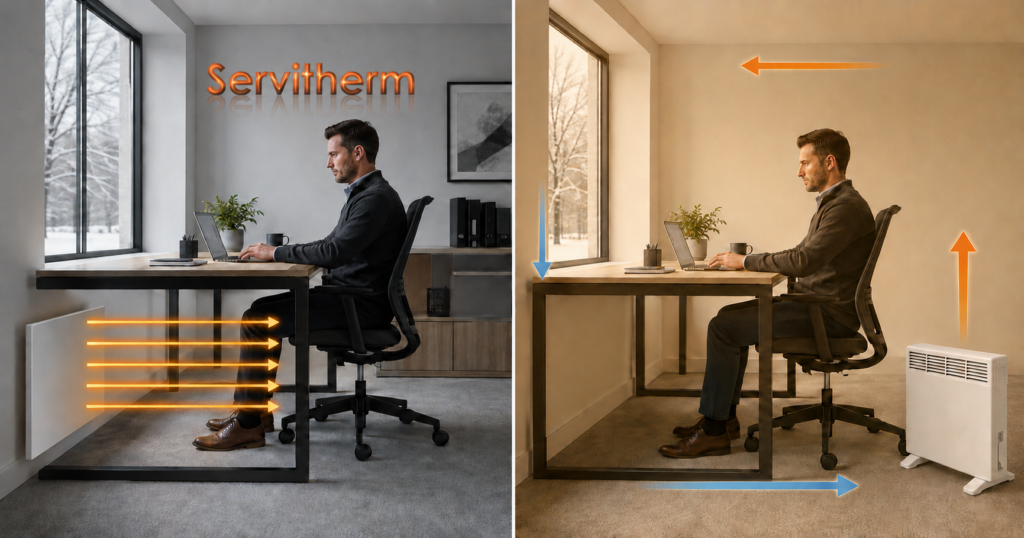
Radiant panel heaters and convection heaters both use electricity to produce warmth, but they distribute that heat in fundamentally different ways.
A radiant panel transfers much of its heat directly towards people, objects and surfaces. A convection heater primarily warms the surrounding air and relies on that air circulating around the room.
Neither method is universally better. The right choice depends on whether you need to warm a defined occupied area or maintain a more consistent air temperature throughout an entire room. For a more in depth look at radiant heating panels take a look at our ultimate guide.
Radiant Heating vs Convection Heating at a Glance
| Feature | Radiant panel heater | Convection heater |
|---|---|---|
| Primary heat transfer | Thermal radiation | Natural or fan-assisted convection |
| What it warms first | People, objects and surfaces | Surrounding air |
| Best suited to | Localised or targeted heating | Whole-room heating |
| Air movement | Limited | Required to distribute heat |
| Response experienced by occupant | Direct warmth once the panel reaches temperature | Gradual warmth as room air circulates |
| Effect of draughts | Direct warmth is less dependent on retaining heated air | Heated air can be displaced more easily |
| Positioning | Must face the intended area | Requires space for air to enter and rise |
| Noise | Silent operation | Passive models are quiet; fan-assisted models create noise |
| Typical application | Desk, reception, checkout or fixed workstation | Bedroom, office or enclosed room |
| Electricity use | Determined by wattage and operating time | Determined by wattage and operating time |
What Is a Radiant Panel Heater?
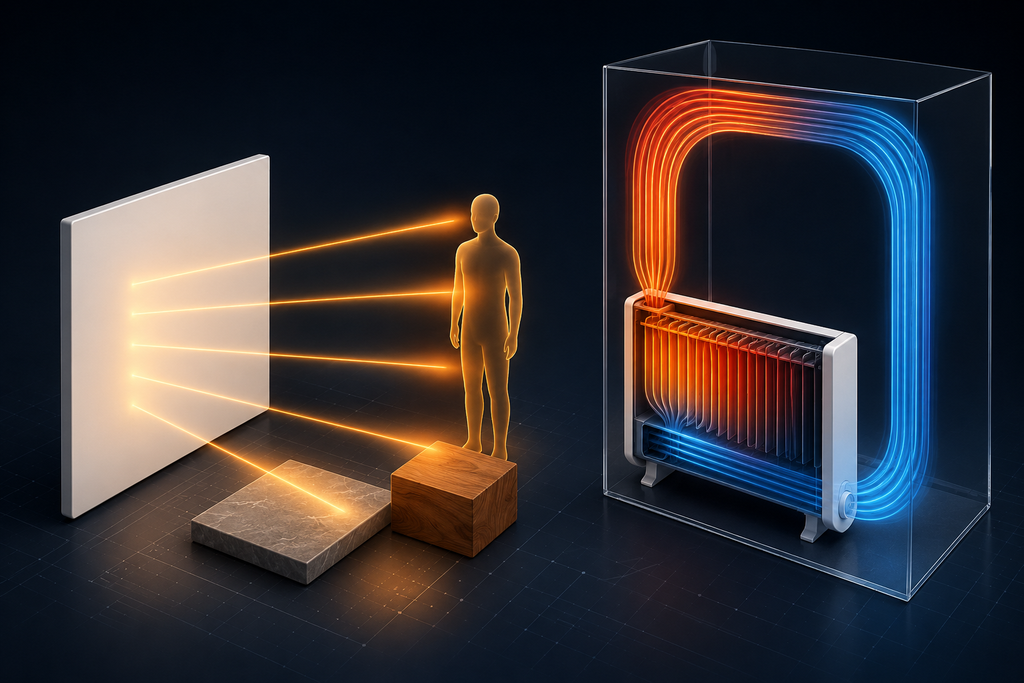
A radiant panel heater contains an electrical resistance element behind a broad, heat-emitting surface. As the panel reaches its operating temperature, its front face emits infrared energy into the area in front of it.
People, furniture, floors and walls absorb this energy and convert it into heat. Those warmed surfaces can then release some of their heat into the surrounding environment.
Radiant panels still warm a certain amount of air. Air touching the panel’s surface becomes warmer and rises naturally, producing some convective output. However, radiation remains the principal method used to deliver warmth towards the intended area.
The CIBSE explanation of radiant heating panels confirms that their output is predominantly radiant while also including some convection caused by air moving across the heated surface.
What Is a Convection Heater?
A convection heater is designed primarily to heat the surrounding air.
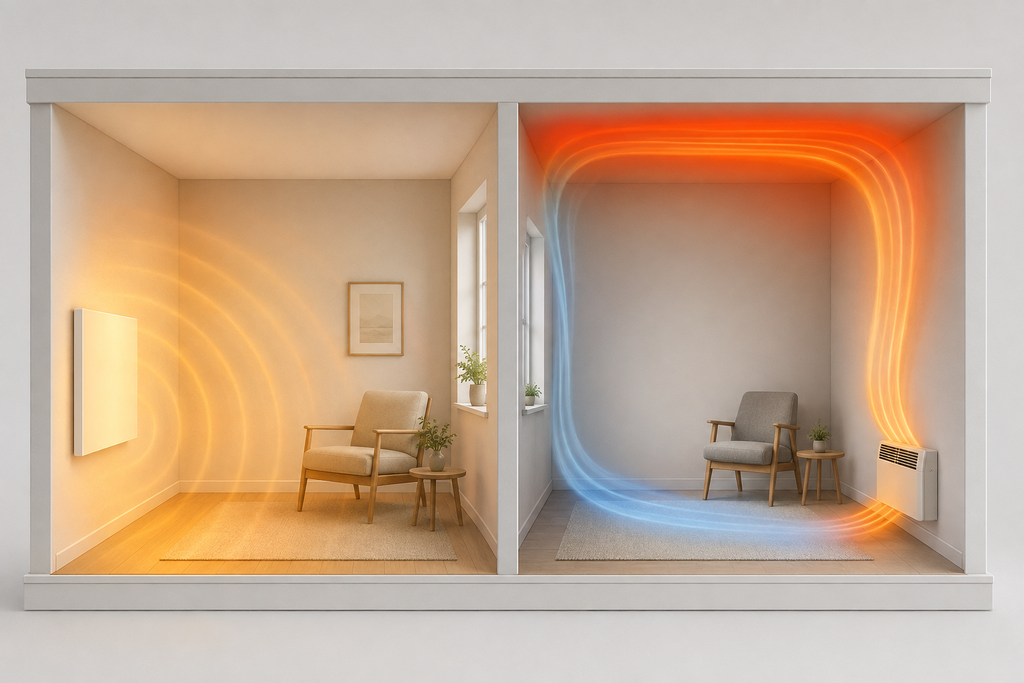
Cooler air enters the heater through openings near its base. The internal heating element raises the air temperature, causing the warmer and less dense air to rise from the top. Cooler air moves in to replace it, creating a continuous circulation pattern.
This process gradually distributes warm air around the room.
There are two principal forms of electric convection heater:
Natural convection heaters
These heaters rely on the natural movement of warm air. They contain no fan and can operate quietly, but it takes time for the circulation process to affect the temperature throughout the room.
Fan-assisted convection heaters
A fan draws air across the heating element and pushes it back into the room. This distributes warmed air more quickly but introduces noise and stronger air movement.
Convector heaters require clear airflow around their inlet and outlet openings. The portable-heater guidance from Electrical Safety First explains that convection heaters need clear space around and above them to operate effectively and can overheat if their grilles become obstructed.
The Main Difference: Surfaces vs Air
The clearest distinction is what each heater warms first.
A radiant panel directs energy towards solid matter, including:
- People
- Clothing
- Furniture
- Desks
- Floors
- Walls
- Other nearby surfaces
A convection heater transfers heat into the air, which must then circulate before warmth becomes more evenly distributed.
This creates two different heating strategies.
Radiant heating is useful when warmth is required at a particular position. Convection is useful when the objective is to increase the general air temperature throughout an enclosed room.
The distinction is not absolute. Radiant panels produce some convection, while warm convection heaters also radiate a certain amount of heat from their surfaces. The classification identifies the dominant method of heat transfer.
How Do They Feel Different?
Air temperature is only one part of thermal comfort. Radiant temperature, air movement, clothing, humidity and activity level also affect how warm a person feels.
A person can feel cold in a room with a reasonable air temperature if the walls, windows and surrounding surfaces are cold. The body continues to exchange radiant heat with those cooler surfaces.
Radiant heating can improve comfort by raising the radiant temperature within the occupied area. The person may therefore feel warmer without a large increase in the temperature of all the air in the room.
The Health and Safety Executive’s workplace thermal-comfort guidance states that radiant temperature can have a greater influence than air temperature on how hot a workplace feels.
Convection heating produces a different sensation. As the room air warms and circulates, the occupant experiences a more general increase in ambient temperature. This can be preferable when people move around the room rather than remaining in a fixed position.
Which Type Produces Heat More Quickly?
This depends on what is being measured.
A radiant panel begins delivering useful warmth towards an occupant as its heat-emitting surface reaches temperature. The user may feel the benefit before the air temperature throughout the room changes substantially.
A convection heater begins warming air as soon as its element reaches temperature, but that warmed air must circulate through the space. A fan-assisted heater can accelerate the process, while a natural convector normally produces a more gradual increase.
Therefore:
- Radiant panels can provide relatively prompt warmth within their effective area.
- Fan heaters can deliver a fast stream of heated air.
- Natural convectors generally warm an enclosed room more gradually.
- Heating an entire room takes longer than warming one defined position.
Warm-up time also depends on the heater’s wattage, construction, controls, room size and starting temperature.
Which Type Is Better in a Draughty Space?
Radiant heating can be advantageous where warm air is difficult to retain.
If an exterior door opens frequently, air warmed by convection can escape and be replaced by colder outdoor air. The heater must then warm the replacement air.
Radiant energy travels towards people and solid surfaces in its path. Although severe draughts will still affect comfort and increase overall heat loss, the user can continue receiving direct radiant warmth even when the surrounding air is cooler.
This makes radiant panels particularly useful around:
- Reception desks
- Retail checkouts
- Ticket windows
- Gatehouses
- Entrance areas
- Frequently opened doors
- Individual workstations
- Other fixed occupied positions
A convection heater may be more appropriate in a reasonably enclosed room where doors and windows remain closed and a consistent air temperature is required throughout.
UK government research into non-domestic heating technologies similarly identifies radiant heating as particularly advantageous where the entire space does not need to be heated, while convection heating is preferable when consistent warmth is required throughout a room or building.
Which Uses More Electricity?
The heating method alone does not determine electricity consumption. Wattage and operating time determine the direct cost.
A 1,000W radiant heater and a 1,000W convection heater will each consume approximately 1kWh of electricity if they operate continuously for one hour.
The relevant calculation is:
Wattage ÷ 1,000 × hours used = electricity consumed in kWh
The possible difference comes from how much of the space needs to be heated.
If only one occupied desk needs additional warmth, a low-wattage radiant panel may be able to address that requirement without raising the temperature throughout a large room. A whole-room convection heater may require a higher output because it is attempting to warm a much greater volume.
This does not mean radiant resistance heating converts electricity into more heat than convection resistance heating. The potential reduction comes from:
- Heating a smaller area
- Directing warmth towards the occupant
- Avoiding unnecessary heating of unused space
- Using a lower-wattage heater for a defined requirement
- Controlling the heater around actual occupancy
Conversely, installing several radiant panels in a room that genuinely requires uniform heating may not be more economical than selecting one properly sized whole-room system.
Does Radiant Heating Reduce Air Movement?
Radiant panels do not need a fan or strong convection current to distribute most of their heat. Air movement caused by the panel is therefore relatively limited.
Natural convection heaters actively depend on warm air rising and cooler air moving in to replace it. Fan-assisted heaters create even more noticeable air movement.
This distinction can matter in:
- Quiet offices
- Reception areas
- Treatment or consultation rooms
- Locations where blowing air feels uncomfortable
- Workstations already affected by draughts
- Areas where loose paperwork is used
It is important not to exaggerate the difference. A passive convection heater does not necessarily produce a strong or unpleasant draught, and a radiant panel still creates some natural air movement as its surface warms.
Do Radiant Panels Produce More Even Warmth?
Radiant panels produce even heat across their surface, but their effect within a room is directional.
The strongest benefit is experienced by people and objects with a clear view of the panel. Someone behind a solid obstruction or outside its effective area will receive less direct radiant energy.
Convection heating can eventually produce a more generally distributed air temperature, but it can still create variation. Warm air rises, so temperatures may be higher near the ceiling and lower at floor level. Large rooms, high ceilings and cold surfaces can increase these differences.
Neither system automatically guarantees uniform comfort. Correct sizing, positioning and control remain essential.
How Does Positioning Differ?
Positioning a radiant panel
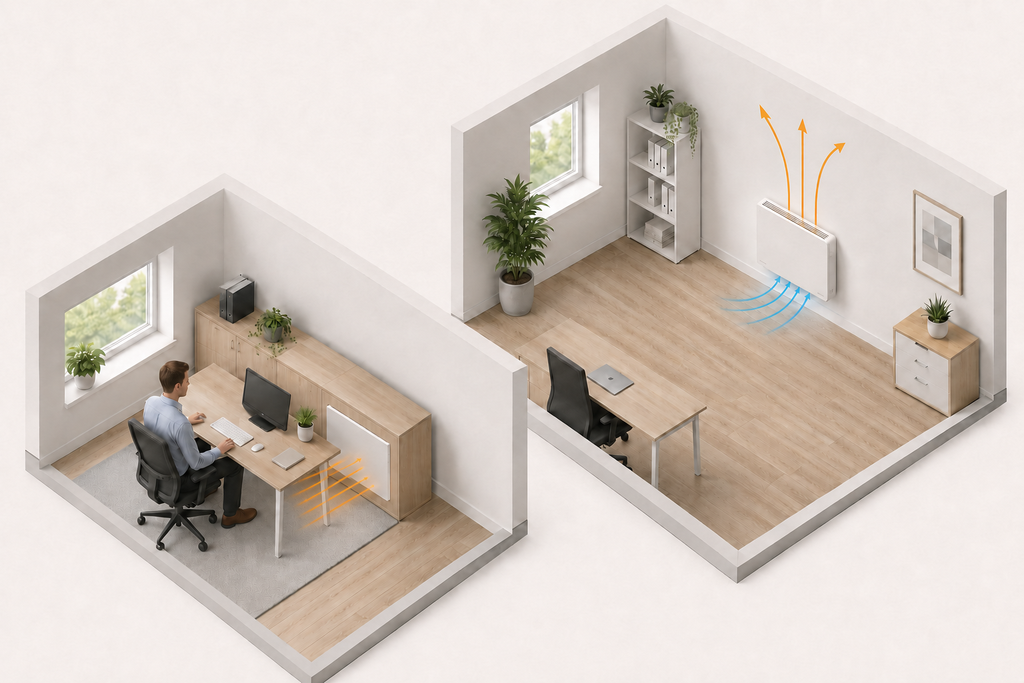
The heat-emitting face should be directed towards the intended occupant or area.
For an under-desk installation, the panel should face the user’s legs. It should not face:
- The floor
- The back of the desk
- An empty walkway
- A drawer unit
- Stored boxes
- Another solid obstruction
Radiant energy travels in a broadly direct path, so furniture and equipment can block it before it reaches the occupant.
Positioning a convection heater
A convection heater needs space for cooler air to enter and warmer air to leave.
Its inlet and outlet grilles should not be covered by:
- Clothing
- Curtains
- Furniture
- Papers
- Stored equipment
- Other combustible materials
Placing a convector underneath an enclosed desk may restrict circulation and concentrate heat in an unsuitable location. Manufacturer installation and clearance instructions should always be followed.
Which Is Quieter?
A radiant panel operates silently because it has no fan or moving components.
A natural convection heater can also be virtually silent, although expansion and contraction of internal components may occasionally produce small clicking sounds.
A fan-assisted convection heater produces audible airflow and motor noise. Whether this is disruptive depends on the heater, its speed and the environment.
Silent operation can be particularly valuable in:
- Offices
- Libraries
- Reception areas
- Consultation rooms
- Bedrooms
- Churches
- Ticket offices
- Other quiet workplaces
Which Takes Up Less Space?
Radiant panels can be manufactured in very slim formats and mounted:
- On a wall
- Beneath a desk
- Behind a counter
- Against the rear of fixed seating
- Within a small occupied enclosure
Their flat construction makes them useful where floor space is limited.
Convection heaters require airflow openings and sufficient internal space for the heating element and air channel. Wall-mounted models can still be relatively slim, but they normally need unobstructed space above and below.
Portable convectors also occupy floor space and require clearance from furniture and other materials.
Which Is Better for a Whole Room?
A convection heater is generally the more straightforward choice when the objective is to increase and maintain the air temperature throughout a small, enclosed room.
Examples include:
- A bedroom
- An enclosed office
- A small meeting room
- A well-insulated spare room
- A room used continuously by several moving occupants
Radiant panels can contribute to whole-room heating, but their size, output and placement must be designed appropriately. A small low-wattage panel intended for localised warmth should not be expected to replace a substantially higher-output room heater.
Which Is Better for One Person or Workstation?
A radiant panel is generally better suited to a fixed occupied position because its heat can be directed towards that person.
Suitable applications include:
- An employee seated at a desk
- A receptionist
- A retail checkout operator
- A ticket-office worker
- A person working in a gatehouse
- A fixed position within a stock room
- An individual church pew or seating area
In these situations, heating the whole room to resolve one local cold spot may consume unnecessary energy and make other occupants too warm.
What Are the Limitations of Radiant Panel Heaters?
Radiant panels are not suitable for every heating requirement.
Potential limitations include:
- Furniture can block the radiant path.
- Their benefit is strongest within a defined area.
- One small panel may not heat an entire large room.
- People moving frequently may spend little time within its effective zone.
- Incorrect orientation can significantly reduce comfort.
- The appropriate wattage and panel size still need to be selected.
- Direct warmth may feel uneven if the panel is too close or poorly positioned.
A radiant panel should be selected for the actual application rather than treated as a universal replacement for central or whole-room heating.
What Are the Limitations of Convection Heaters?
Convection heaters also have practical limitations:
- Warm air can escape when doors or windows open.
- Air temperatures can vary between floor and ceiling level.
- Heating an entire room may be unnecessary for one occupant.
- Furniture can obstruct airflow.
- Fan-assisted models can be noisy.
- Warm-air movement may be uncomfortable in some positions.
- High-output portable units can place a substantial load on an electrical circuit.
Convection heaters perform best when their output is properly matched to an enclosed space and air can circulate freely.
Radiant Panel or Convection Heater: Which Should You Choose?
Choose a radiant panel heater when:
- You need to warm a defined occupied area.
- The user remains in one position.
- The space is draughty or frequently opened.
- Silent operation is important.
- Floor space is limited.
- You want to supplement rather than replace the main heating system.
- Heating the entire room would be unnecessary.
Choose a convection heater when:
- You need a consistent air temperature throughout the room.
- Occupants move around frequently.
- The space is reasonably enclosed.
- There is sufficient room for air to circulate.
- The heater is expected to provide general room heating.
- Directional warmth would leave important areas uncovered.
Some buildings benefit from using both. A central system can maintain a moderate background temperature while local radiant panels address individual cold spots and fixed workstations.
The Final Difference
The difference between radiant panel heaters and convection heaters is not simply their appearance. It is the way they deliver warmth.
A convection heater warms and circulates air throughout a space. A radiant panel directs much of its energy towards people and surfaces within a defined area.
Convection is usually better suited to maintaining general warmth throughout an enclosed room. Radiant heating is particularly useful when comfort is required at a specific desk, counter, workstation or other occupied position.