
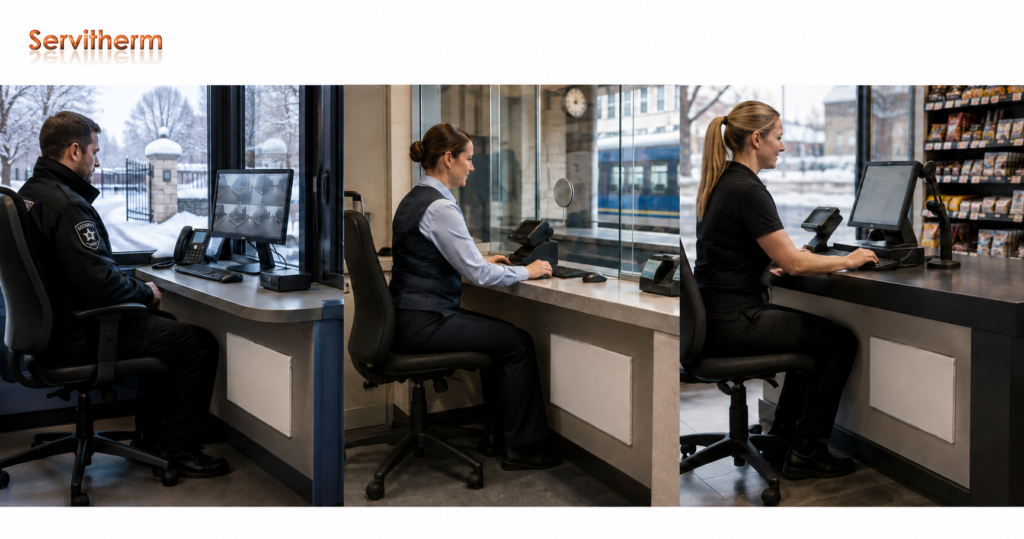
Gatehouses, ticket offices and fixed retail workstations often experience heating problems that are difficult to solve with a conventional whole-room system.
The employee may remain seated or stand in one position for long periods, while doors, service windows and loading-bay entrances repeatedly allow warm air to escape. Large glazed areas can also create cold surfaces and uncomfortable downdraughts. Raising the temperature throughout the building may consume more energy without resolving the discomfort at the occupied workstation.
Localised radiant heating offers a different approach: directing supplementary warmth towards the person and their immediate surroundings rather than attempting to heat every part of the space equally.
Why These Workstations Can Feel Cold
A gatehouse may be a small enclosure, but it can lose heat rapidly through windows, lightly insulated walls and doors opened for drivers or visitors. Ticket-office staff may work beside a frequently used entrance or communicate through an external service window. Retail employees can be positioned near automatic doors, open-fronted displays or draughty checkout areas.
These environments combine several sources of discomfort:
- Low levels of physical activity
- Repeated exposure to incoming cold air
- Large areas of external glazing
- Cold surrounding surfaces
- Limited space for conventional radiators
- Heating empty circulation areas as well as occupied positions
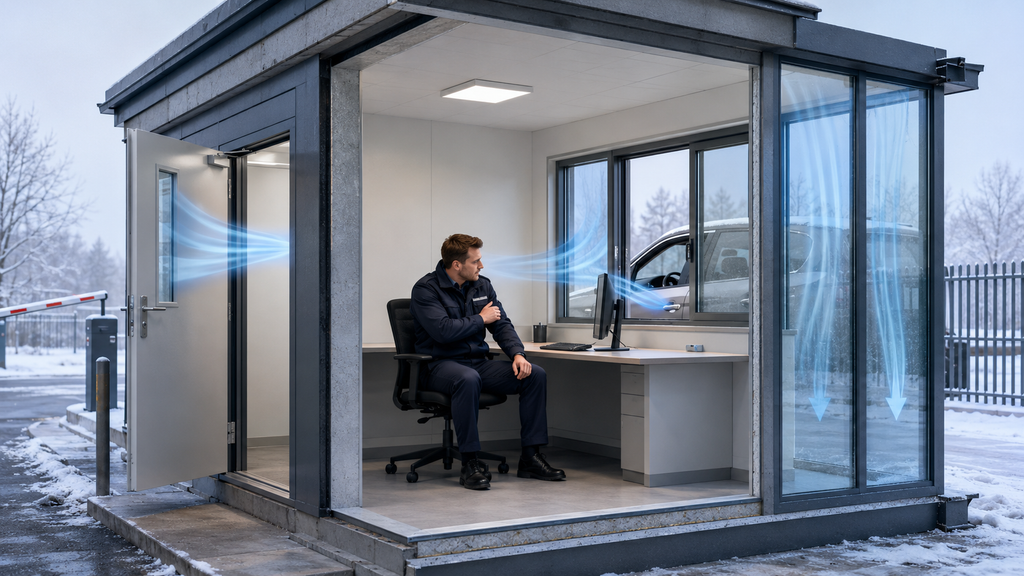
Air temperature alone does not determine whether someone feels comfortable. Air movement, radiant temperature, humidity, clothing and work rate all contribute. A seated gatehouse attendant will therefore experience the same room differently from an employee walking continuously around a shop.
What Is Localised Heating?
Localised heating concentrates additional warmth around a defined workstation. It can supplement the building’s main heating system or provide a practical control where maintaining the same temperature throughout the room is difficult.
The UK Health and Safety Executive states that indoor workplaces should normally maintain at least 16°C, or 13°C where the work involves rigorous physical effort. It also identifies local heating as an option where a comfortable temperature cannot be maintained throughout a workroom. Employers can review the complete recommendations in the HSE’s guidance on managing workplace temperatures.
A local heater does not remove an employer’s wider responsibilities. Workplace temperature, ventilation, draughts and employee feedback must still form part of the risk assessment.
How Radiant Panels Provide Targeted Warmth
A radiant panel produces thermal radiation that travels towards nearby people and surfaces. Unlike a fan heater, it does not depend entirely on continually moving warmed air around the room.
This distinction can be useful beside frequently opened doors or service windows. Heated air may escape quickly, whereas a correctly directed radiant panel can continue transferring warmth towards the occupied position.
The panel does not create an invisible barrier against draughts, and it will not correct inadequate insulation. Its purpose is to improve conditions at a specific workstation as part of a broader heating strategy.
Localised Heating in Gatehouses
Gatehouses and security lodges often contain a desk, monitoring equipment and extensive glazing within a compact footprint. The attendant may also need to open a door or window repeatedly to check identification and communicate with drivers.
A slim panel may be installed beneath the desk, on a suitable side wall or behind the seated position, depending on the layout. It should face the employee’s occupied area without restricting access to controls, emergency exits or security equipment.
Before adding a heater, operators should inspect window seals, door closers and gaps around cable entries. Addressing uncontrolled draughts can reduce heat loss, although intentional ventilation openings must not be blocked.
Heating Ticket Offices and Service Counters
Ticket-office employees can be separated from customers by glazing while remaining exposed to cold air through communication openings, document trays or doors leading to platforms and concourses.
A local radiant panel can provide supplementary warmth around the lower body without obstructing the counter. The installation must preserve legroom and avoid contact with chairs, bags, paperwork or electrical equipment.
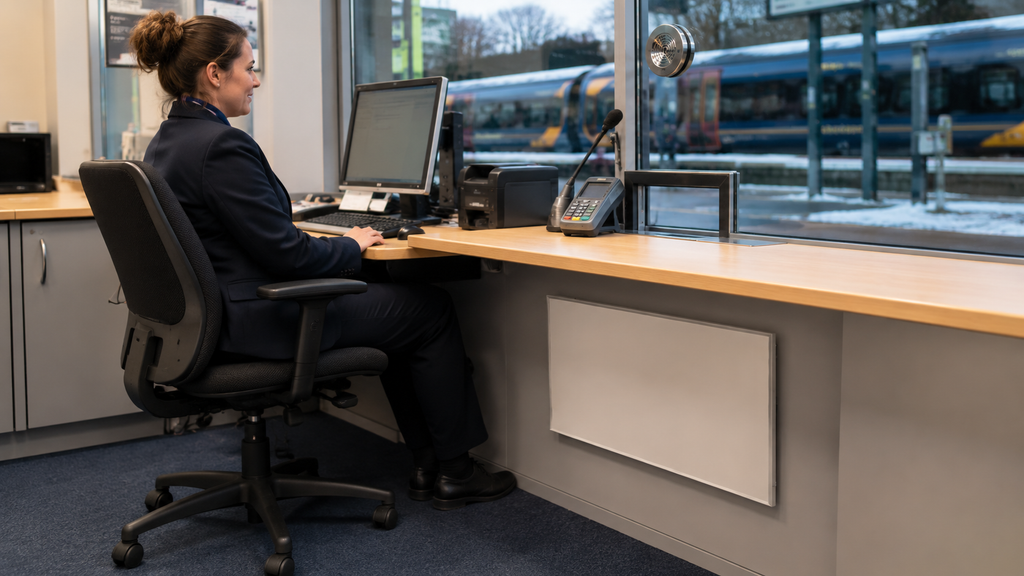
The panel should not be placed directly beneath a counter containing heat-sensitive equipment. Payment terminals, computers and cable bundles require suitable ventilation and clearance, so the complete workstation must be assessed rather than treating the available wall space in isolation.
Retail Checkouts and Fixed Workstations
Checkout operators, reception staff and employees working at service desks may remain in one position while customers and other workers move around a much larger environment.
Heating the entire sales floor to address one cold checkout may be inefficient, particularly when the workstation is close to an entrance. A local panel can focus supplementary warmth on the staff side without directing excessive heat towards customers, stock or conveyor equipment.
The unit must not project into customer routes or create a surface that can be touched accidentally. Cables should be securely routed away from feet, trolleys, cleaning equipment and moving components.
Positioning the Panel Correctly
Effective positioning depends on the relationship between the panel and the employee—not simply the size of the room.
For lower-body warmth, the panel should face the employee’s legs while maintaining the manufacturer’s required clearance. It should not point towards the underside of a desk if that prevents the warmth reaching the user.
The installation should also avoid:
- Direct contact with clothing or personal belongings
- Obstruction by solid desk panels or stored boxes
- Exposed or trailing power cables
- Placement beside combustible materials
- Restriction of escape routes or workstation movement
- Locations vulnerable to impacts or liquid spills
Employees must be able to move away from the heat or reduce its output if they become uncomfortable.
Controls, Monitoring and Energy Use
Thermostatic control helps prevent a panel from operating unnecessarily. The temperature sensor should be positioned where it can measure representative conditions without being directly heated by the panel or exposed to a strong draught.
Timers or occupancy-based controls may be appropriate for workstations used only during particular shifts. However, operating schedules must reflect actual staffing arrangements rather than assumed opening hours.
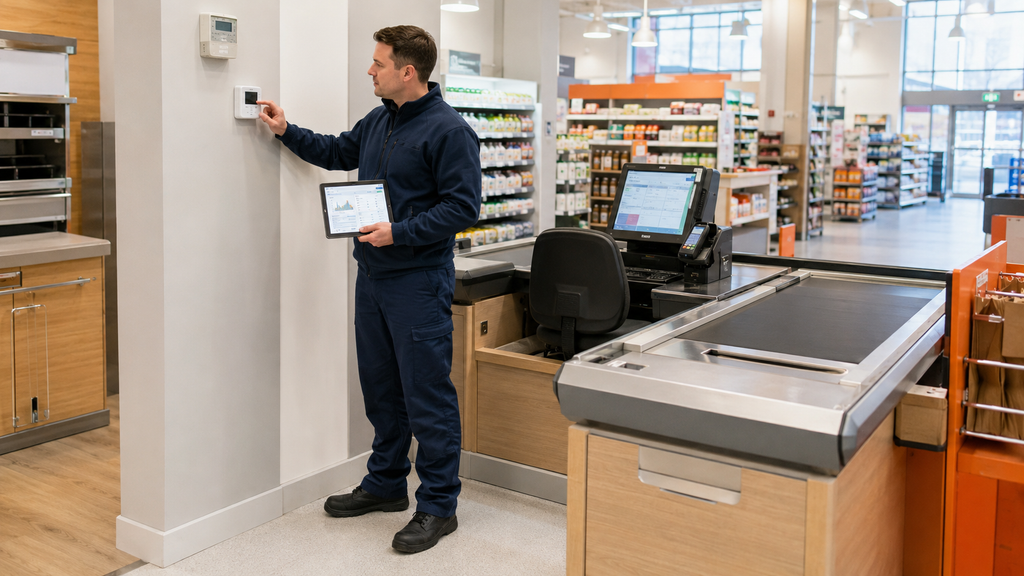
Energy use can be calculated by multiplying the heater’s kilowatt rating by its operating time. For example, a 200-watt panel running for five hours consumes 1 kilowatt-hour. A thermostat may reduce actual operating time, but the result depends on the workstation, weather and control settings. Savings should therefore be measured rather than guaranteed.
Choosing a Servitherm Panel
Servitherm Slimline radiant panels are available in outputs from 100 to 310 watts and in several dimensions. This allows the panel to be selected according to the available mounting area and intended heating zone.
The correct output depends on workstation layout, distance from the employee, surrounding surfaces, draughts and background temperature. Choosing the highest wattage automatically is not necessarily the best approach; appropriate positioning and control can be equally important.
A Practical Approach to Workstation Comfort
Localised heating is most effective when it forms part of a considered workplace-temperature plan. Employers should first address preventable draughts, poor seals and unsuitable workstation positioning while preserving adequate ventilation.
Where a gatehouse, ticket office or retail workstation remains difficult to heat evenly, a correctly specified radiant panel can provide supplementary warmth where it is actually needed. The result is a more focused solution for fixed employees without unnecessarily treating every circulation area, corridor or unoccupied part of the building as though it has the same heating requirement.