
A low-wattage radiant panel heater can cost approximately 2.61p to 8.09p per hour to run, depending on its wattage. This is based on an electricity unit rate of 26.11p per kilowatt-hour (kWh).
The precise cost will depend on:
- The wattage of the panel
- Your electricity unit rate
- How long the heater operates
- Whether it is controlled by a thermostat
- The temperature selected
- The conditions within the space
Because radiant panels can provide warmth to a specific person or occupied area, they can be a practical alternative to raising the temperature throughout an entire building.
Radiant Panel Heater Running Costs at a Glance
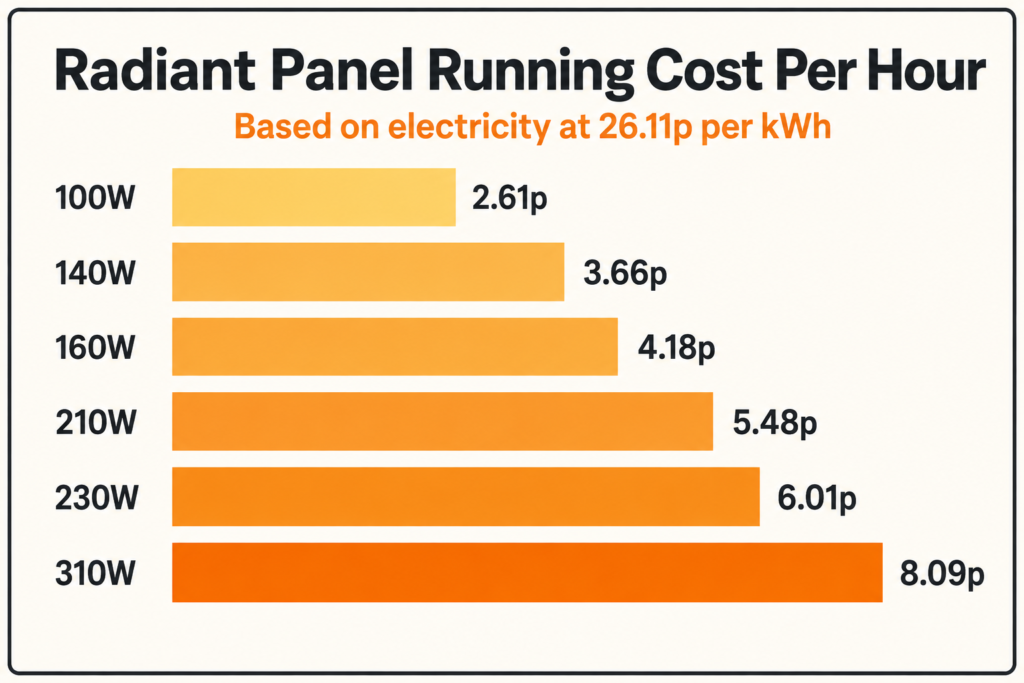
The table below uses the Ofgem average electricity unit rate of 26.11p per kWh for customers paying by Direct Debit under the energy price cap from 1 July to 30 September 2026.
| Panel wattage | Cost per hour | Cost for 8 hours | Cost for 22 working days |
|---|---|---|---|
| 100W | 2.61p | 20.89p | £4.60 |
| 140W | 3.66p | 29.24p | £6.43 |
| 160W | 4.18p | 33.42p | £7.35 |
| 210W | 5.48p | 43.86p | £9.65 |
| 230W | 6.01p | 48.04p | £10.57 |
| 310W | 8.09p | 64.75p | £14.25 |
These figures represent the maximum cost if the heater draws its full rated wattage continuously for the entire period. A thermostat may reduce actual consumption by switching the panel off after the required temperature has been reached.
Electricity prices vary by tariff, payment method and region. Businesses are also usually supplied under commercial energy contracts rather than the domestic energy price cap, so you should substitute the unit rate shown on your own electricity bill.
How to Calculate the Running Cost of a Radiant Panel Heater
You only need three pieces of information:
- The wattage of the heater
- The number of hours it will operate
- Your electricity price per kWh
The calculation is:
Heater wattage ÷ 1,000 × hours used × electricity price per kWh
Dividing by 1,000 converts watts into kilowatts.
For example, a 210W radiant panel operating for five hours at an electricity rate of £0.2611 per kWh would cost:
210 ÷ 1,000 × 5 × £0.2611 = £0.2742
The total cost would therefore be approximately 27.42p.
A simpler hourly calculation
To find the hourly cost, divide the wattage by 1,000 and multiply it by your electricity unit rate:
210 ÷ 1,000 × £0.2611 = £0.0548 per hour
That is approximately 5.48p per hour.
How Much Does a 100W Radiant Panel Cost to Run?
At 26.11p per kWh, a 100W panel costs approximately:
- 2.61p per hour
- 20.89p over eight hours
- £1.04 for a 40-hour working week
- £4.60 over 22 working days
- £54.31 over 260 eight-hour working days
A panel of this size may be suitable for providing supplementary warmth to a small, clearly defined area. Its effectiveness will depend on positioning, distance and the amount of heat required.
How Much Does a 210W Radiant Panel Cost to Run?
A 210W panel costs approximately:
- 5.48p per hour
- 43.86p over eight hours
- £2.19 for a 40-hour working week
- £9.65 over 22 working days
- £114.04 over 260 eight-hour working days
This calculation assumes that the heater draws 210W continuously. If a thermostat switches the panel off for part of the day, its actual electricity consumption will be lower.
How Much Does a 310W Radiant Panel Cost to Run?
At the same unit rate, a 310W radiant panel costs approximately:
- 8.09p per hour
- 64.75p over eight hours
- £3.24 for a 40-hour working week
- £14.25 over 22 working days
- £168.36 over 260 eight-hour working days
Although a larger panel consumes more electricity per hour, it also provides a greater heating output. The smallest panel is therefore not automatically the most appropriate or economical choice.
An undersized heater may need to remain on continuously without providing the required level of comfort. Choosing a panel that is properly matched to its intended position and application is more useful than selecting one on wattage alone.
Does the Standing Charge Need to Be Included?
No. The electricity standing charge does not normally need to be included when calculating the additional cost of operating a heater.
The standing charge is paid each day for access to the electricity supply, regardless of whether the radiant panel is switched on. It forms part of the building’s overall energy bill but is not caused by the heater itself.
To calculate the direct operating cost of a radiant panel, use the electricity unit rate in pence per kWh.
Will a Thermostat Reduce the Running Cost?
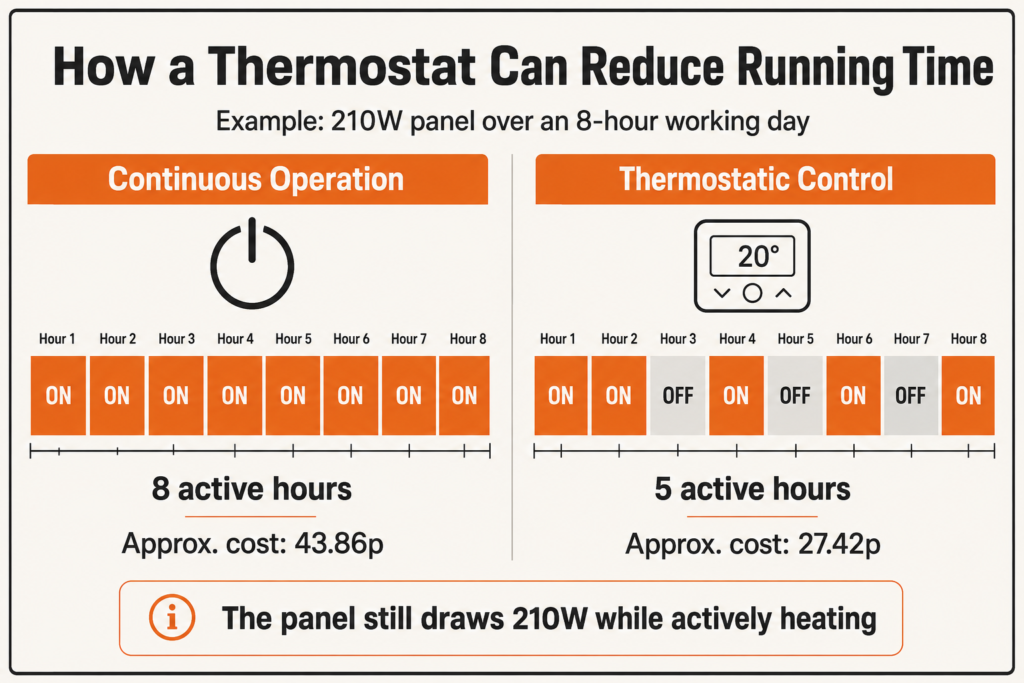
A thermostat can reduce electricity consumption by preventing the heater from operating continuously when the selected temperature has already been reached.
A 210W panel always draws approximately 210W while it is actively heating. The thermostat does not change its active wattage. Instead, it reduces the total amount of time for which power is supplied.
For example, if a 210W panel is available for an eight-hour working day but is actively heating for only five of those hours, its approximate cost would be:
0.21kW × 5 hours × £0.2611 = 27.42p
Without thermostatic cycling, eight hours of continuous operation would cost approximately 43.86p.
Actual cycling will vary according to:
- The thermostat setting
- Indoor and outdoor temperatures
- Insulation
- Draughts and open doors
- The size of the area
- The panel’s position
- Other sources of heat
- How frequently the space is occupied
The thermostat should be positioned where it can measure representative conditions. Placing it directly beside the heater, in strong sunlight or within a cold draught may produce misleading readings.
Are Radiant Panels Cheaper Than Other Electric Heaters?
When two direct electric heaters have the same wattage and operate for the same length of time, their basic electricity cost will be the same.
For example:
- A 300W radiant panel uses 0.3kWh in one hour.
- A 300W convector uses 0.3kWh in one hour.
- At 26.11p per kWh, either would cost approximately 7.83p for that hour.
The potential difference is how the heat is used.
A radiant panel can be positioned to warm a person, workstation or small occupied area directly. A conventional heater may be selected to raise the air temperature throughout a much larger space.
A 2,000W fan or convector heater running continuously at 26.11p per kWh would cost approximately 52.22p per hour. A 210W radiant panel would cost approximately 5.48p per hour.
That does not mean the 210W panel produces the same total amount of heat as the 2,000W heater. It means that localised heating may avoid using a much higher output where only one small area requires additional warmth.
The Importance of Positioning
Running cost cannot be considered separately from positioning. A poorly placed panel may consume relatively little electricity but fail to provide useful warmth.
Radiant heat travels from the face of the panel towards people and surfaces within its effective area. The path should not be obstructed by:
- Boxes
- Drawers
- Furniture
- Stored equipment
- Desk panels
- Bags or clothing
For under-desk heating, the active face of the panel should be directed towards the occupant’s legs. Mounting it so that it faces the floor, the rear of a desk or an empty section of the room will reduce the benefit experienced by the user.
Correct positioning allows the available heat output to be used more effectively without increasing the panel’s wattage.
When Can Localised Radiant Heating Reduce Overall Consumption?
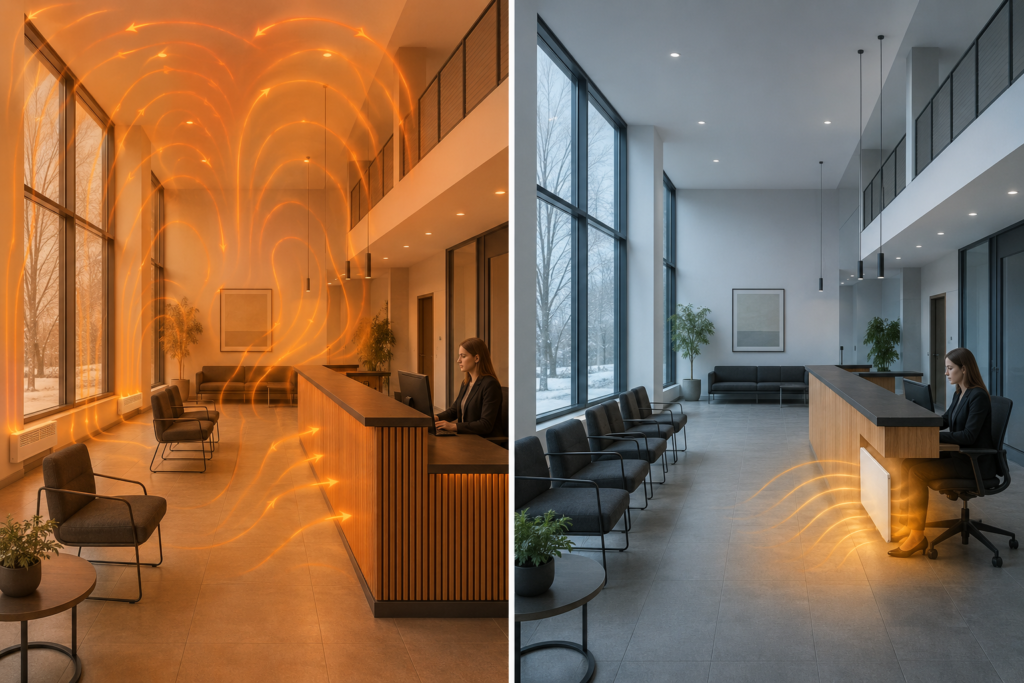
Localised radiant heating is most useful where the whole building does not need to be heated uniformly.
Examples include:
- A single reception desk
- An individual office workstation
- A retail checkout
- A ticket office
- A gatehouse
- A stock room used intermittently
- A church pew
- A small animal enclosure
- A specific cold spot within a larger building
If one employee feels cold at a reception desk, increasing the temperature throughout an entire reception area could require far more energy than providing a low-wattage panel at that position.
The comparison should therefore be between the realistic heating options for the application, rather than simply comparing one heater’s hourly cost with another.
How to Estimate Your Likely Monthly Cost
For a more realistic estimate, follow these steps:
- Find the panel wattage on its product information or rating label.
- Check your electricity bill for the unit rate per kWh.
- Estimate how many hours per day the panel will be actively heating.
- Multiply that figure by the number of days it will be used.
- Repeat the calculation for winter and milder months if usage changes seasonally.
For example, a 160W panel used for six active heating hours per day across 22 working days would consume:
0.16kW × 6 hours × 22 days = 21.12kWh
At 26.11p per kWh, the approximate monthly cost would be:
21.12kWh × £0.2611 = £5.51
If the building is on a commercial tariff of 30p per kWh, the same usage would cost:
21.12kWh × £0.30 = £6.34
Using your actual tariff produces a much more useful estimate than relying on a national average.
How Can You Keep Running Costs Under Control?
Practical ways to manage the cost of a radiant panel include:
- Select a wattage appropriate for the application
- Position the panel directly towards the occupied area
- Keep the heat path free from obstructions
- Use an appropriate thermostat
- Avoid setting the temperature unnecessarily high
- Switch off heating in unoccupied areas
- Address excessive draughts where practical
- Review operating hours regularly
- Calculate costs using your actual electricity tariff
The objective is not simply to install the lowest-wattage heater available. It is to deliver sufficient warmth using the least unnecessary energy.
So, How Much Will a Radiant Panel Heater Cost to Run?
At an electricity rate of 26.11p per kWh, a Servitherm radiant panel rated between 100W and 310W would cost approximately 2.61p to 8.09p per hour while actively heating.
A thermostat may reduce the amount of time the panel draws power, while correct positioning helps ensure that the heat produced reaches the intended person or area.