
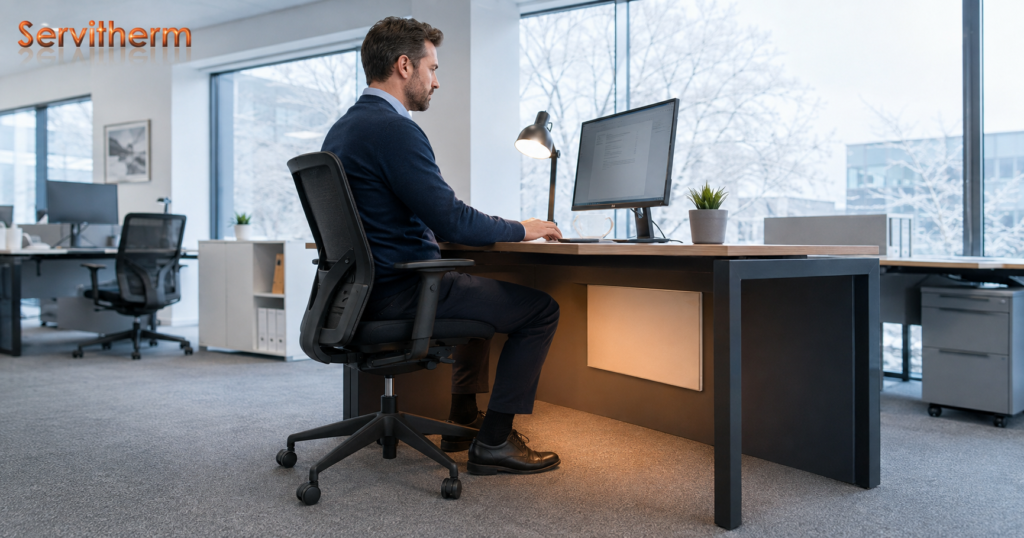
An office can meet its general temperature target while individual employees still feel uncomfortably cold. Desks beside entrances, external walls, large windows or ventilation outlets are particularly vulnerable to draughts and cold surrounding surfaces.
Increasing the central-heating setting may warm the entire room, including areas that are already comfortable. Under-desk heating offers a more targeted option by placing warmth close to the person experiencing the problem.
A slim radiant panel can be installed beneath a suitable desk with its surface directed towards the employee’s legs. It can then provide supplementary warmth around the occupied workstation without being expected to heat the whole office.
Why Can One Office Desk Feel Colder Than Another?
Temperature alone does not determine whether someone feels comfortable at work. Air movement, humidity, clothing, activity level and the temperatures of nearby surfaces can all affect thermal comfort.
Two employees in the same room may therefore experience different conditions. One might be seated in the centre of the office, while another works beside glazing or an external door that opens throughout the day.
Common causes of cold workstations include:
- Draughts from doors, windows or ventilation systems
- Desks positioned against cold external walls
- Large glazed areas during winter
- Reception desks close to building entrances
- Differences in individual temperature preference
- Employees remaining seated for extended periods
- Partially occupied offices with uneven heating requirements
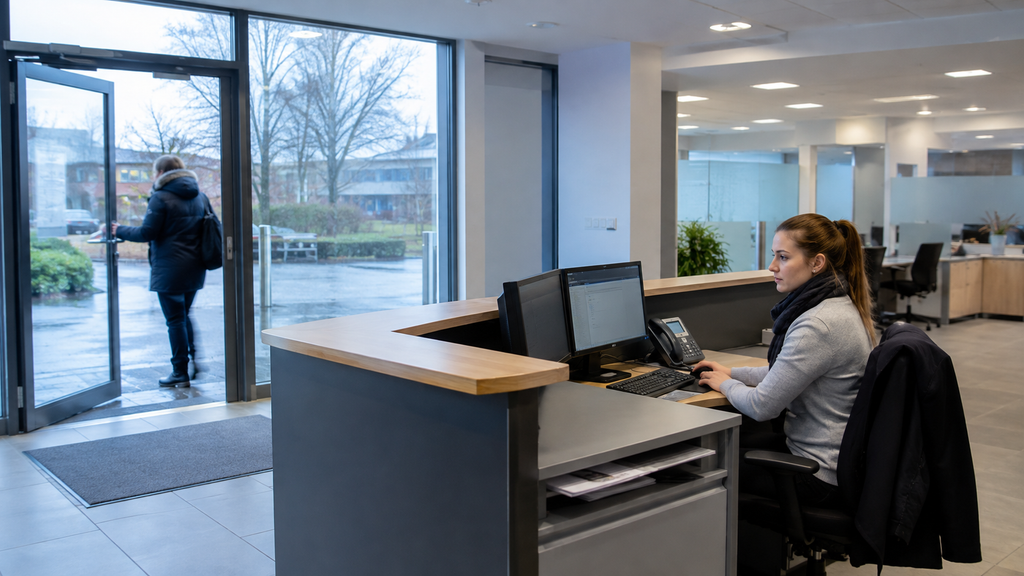
The Health and Safety Executive explains that thermal comfort is influenced by environmental and personal factors. Its guidance identifies measures such as reducing draughts, allowing appropriate thermostat adjustment and providing personal heaters where suitable as ways of improving workplace thermal comfort.
Before adding local heating, employers should establish why the workstation is cold. A damaged window seal, badly directed ventilation outlet or inadequate main heating system may require correction rather than concealment.
How Does Under-Desk Radiant Heating Help?
An under-desk radiant panel is positioned near the occupied workstation rather than elsewhere in the room. Its purpose is to provide local supplementary warmth to the employee’s lower body.
This is different from turning up the central heating. Raising a room thermostat asks the main system to increase the temperature across a much larger area. A local panel concentrates its output around one defined position.
Under-desk heating can be particularly useful when:
- Only one or two workstations require additional warmth
- Employees use the office intermittently
- A reception desk is exposed to repeated door opening
- The main heating adequately serves most of the room
- The workstation has a suitable fixed mounting location
- Heating the entire building to address one cold desk would be disproportionate
The potential benefit depends on how the panel is used. Local heating does not automatically reduce energy consumption. Savings are most plausible where targeted warmth avoids increasing the setting or operating time of a substantially larger heating system.
For a technical explanation of radiant heat transfer, read our guide to how radiant panel heaters work.
Where Should an Under-Desk Heater Be Positioned?
Positioning determines whether an under-desk panel provides useful warmth or simply heats an unoccupied part of the desk.
The broad face of the panel should point towards the employee’s legs, with sufficient unobstructed space between the panel and the occupied position. It should not face away from the user or be hidden behind drawers, stored boxes or cable bundles.
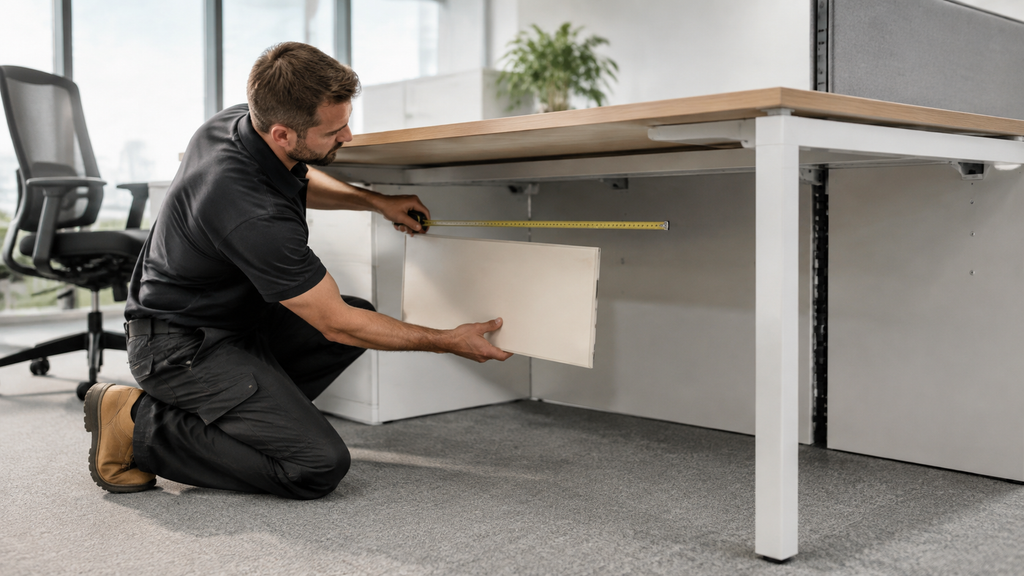
A suitable installation should:
- Preserve comfortable leg and knee clearance
- Keep the panel clear of accidental contact
- Avoid obstructing chair movement
- Maintain the manufacturer’s required clearances
- Keep paperwork, bags and stored items away from the heated surface
- Protect the supply cable from feet, chair wheels and cleaning equipment
- Allow access to the heater’s controls or isolating switch
The panel should be securely fitted to an appropriate desk surface or supporting structure. Its mounting position must not weaken the furniture or encourage employees to use it as a footrest.
Freestanding portable heaters can be moved, knocked over or placed too close to combustible materials. A properly planned fixed position provides greater control over orientation and clearances.
Controls and Responsible Operation
Localised heating should operate only when the workstation is occupied and additional warmth is required. Leaving a personal heater running beneath an empty desk wastes electricity and can introduce avoidable risk.
Depending on the installation, suitable controls may include:
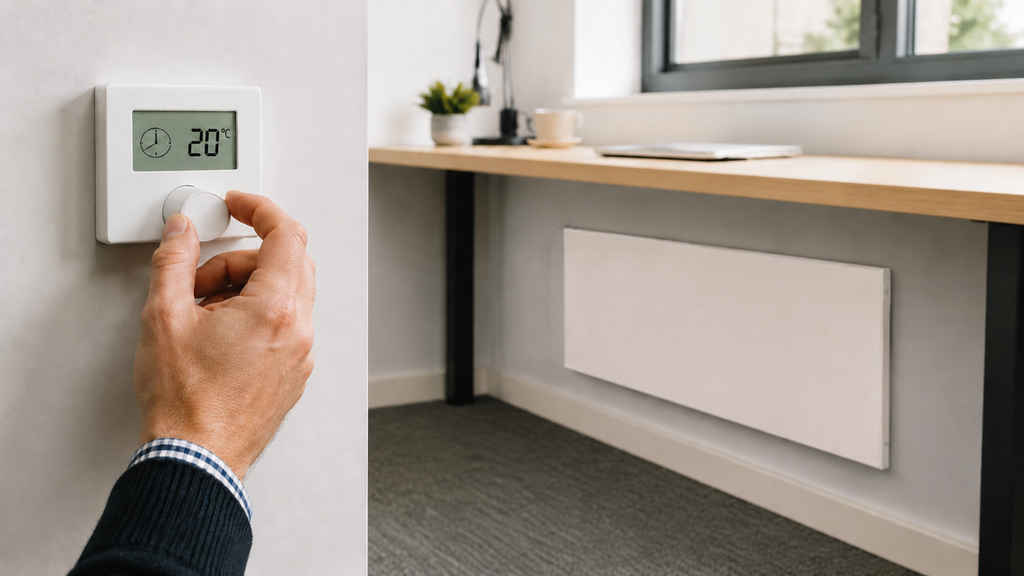
- A straightforward on-and-off control
- A timer matched to working hours
- A thermostat serving the local area
- An accessible switched supply
- Automatic control selected for the intended application
Employees should understand how to operate the heater and know that it must not be covered. Workplace procedures should also prevent boxes, coats, bags or wastepaper bins from gradually being placed against it.
Running cost can be estimated from the heater’s rated power:
Power in kilowatts × operating hours × electricity unit rate
For example, a 200W panel uses 0.2kW. If it operates for five hours, it consumes 1kWh of electricity. The financial cost then depends on the organisation’s electricity tariff. This calculation is more reliable than quoting a fixed daily cost, because commercial electricity rates and operating periods vary.
Choosing a Servitherm Panel for a Workstation
The Servitherm Slimline Panel Heater range operates from 100W to 310W, allowing the panel size and output to be matched more closely to the intended position. The panels normally operate at a surface temperature of approximately 60°C to 70°C and incorporate thermal cut-out protection.
Selecting a panel should account for:
- Available mounting space
- Distance from the employee
- Desk construction and stability
- Required output
- Daily occupancy
- Access to an appropriate electrical supply
- Cable routing and workplace cleaning arrangements
- The need for thermostatic or timed control
The smallest available panel should not automatically be selected simply because it fits. Equally, specifying more output than the workstation requires may create unnecessary heat. The application and installation position should be assessed together.
Is Under-Desk Heating Right for Your Office?
Under-desk radiant heating is best suited to a clearly identified local comfort problem. It can be useful for reception desks, individual office workstations, home offices and seated employees positioned near cold external surfaces or regularly opened entrances.
It is not a substitute for maintaining a reasonable workplace temperature, repairing draughts or addressing a deficient main heating system. The Workplace (Health, Safety and Welfare) Regulations require indoor workplace temperatures to be reasonable, and any method of heating must not expose employees to harmful or offensive fumes.
When the wider office is adequately heated but one workstation remains uncomfortable, a correctly positioned and controlled radiant panel can provide a practical layer of supplementary warmth.
Contact Servitherm for help selecting a suitable panel size, output and control arrangement for your workstation.